


You're staring at a deadline, a stack of blanks, and a design file that looked perfect on screen but printed dull on the last run. Maybe your printer is down, your screen setup costs too much for a short order, or half your film ends up in the trash because the layout never quite fits. That's the point where most shops stop trying to do everything in house and start ordering ready to press transfers instead.
Why Custom Apparel Buyers Switch to DTF Transfers
The breaking point usually isn't one bad shirt. It's the Thursday order for a school event, the brand client who wants the same logo in three sizes, and the team roster that changes names at the last minute, all landing at once. Your current method handles one of those jobs well. It doesn't handle all three without new screens, wasted blanks, or a weekend spent babysitting a printer.
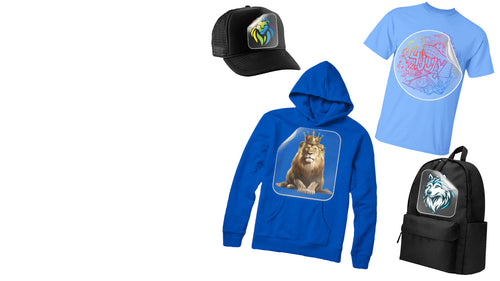
That's where a Lion Transfer fits in practical terms. It means a ready to press Direct-to-Film print supplied to you already printed, powdered, and cured, so your job starts at the heat press instead of at the printer. You upload artwork, choose a size or build a sheet, and press what arrives onto cotton, polyester, blends, and other fabrics your customers bring you.
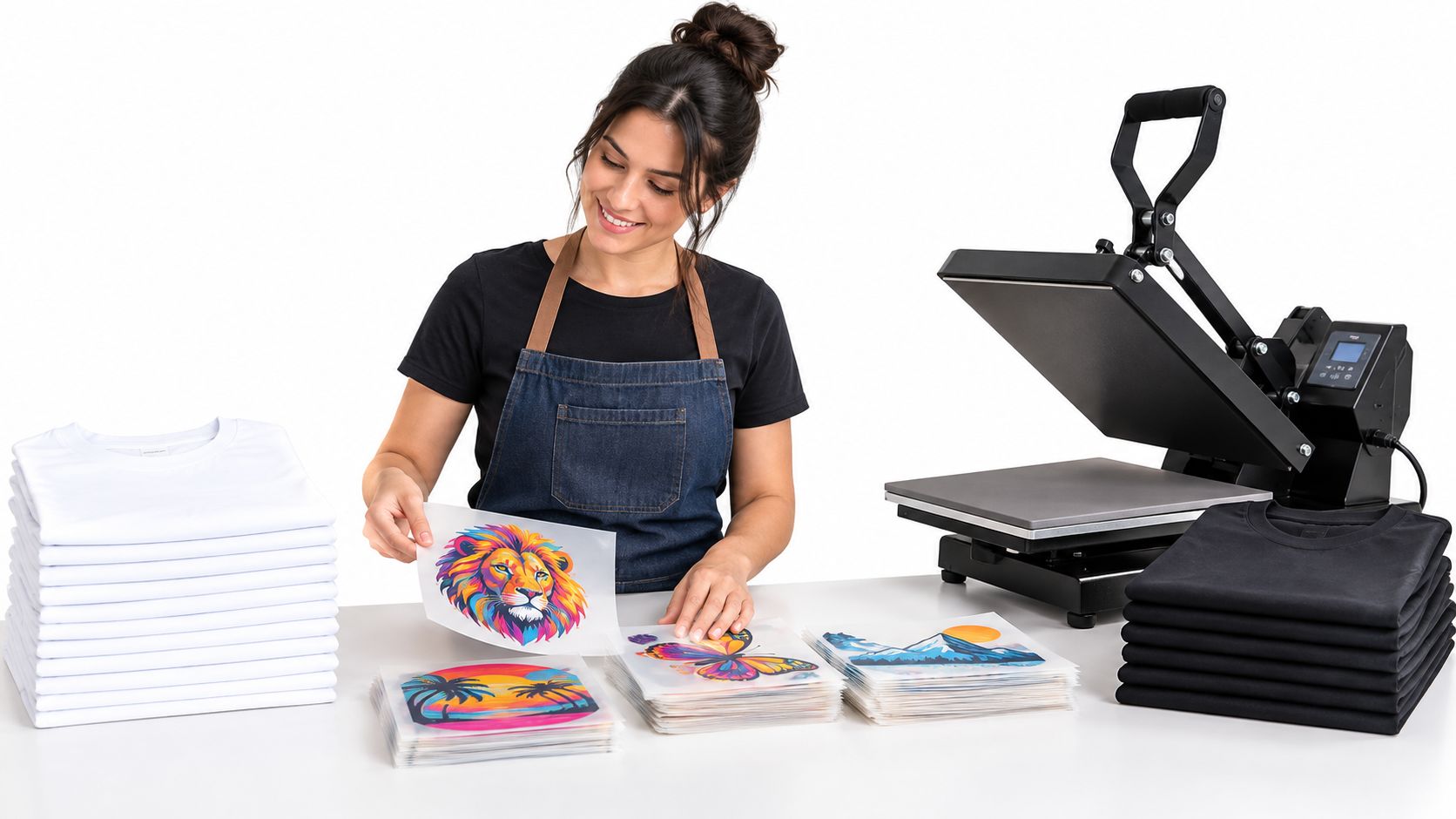
This isn't a niche workaround anymore. DTF accounted for an estimated 50% of all T-shirts produced globally in 2024, approximately 7 billion items, according to the Fibre2Fashion industry report summarized in digital textile market research. The surrounding market matters too, because it explains why inks, films, and presses keep improving instead of disappearing next season.
The Problems Buyers Are Actually Solving
- Color that shifts between blanks: Digital printing with a white ink base helps the same artwork sit more consistently on light and dark garments.
- Small runs that don't justify setup: You can order variable artwork without building a screen for every design.
- Wasted material: Layout choices, covered later in detail, decide whether you pay for usable transfers or empty film.
- Capacity limits: Outsourcing the print step lets your press and your staff stay focused on finishing and shipping.
Shop floor rule: If a job needs full color, variable names or sizes, and a fast turnaround, don't price it like a long screen run. Price the transfer, the blank, and your press time, then decide.
The trade-off is control. You're trusting someone else's curing, powder coverage, and color management. That's why the rest of your decisions, from file prep to press settings, matter more than any sales claim.
How Direct-to-Film Transfers Actually Work
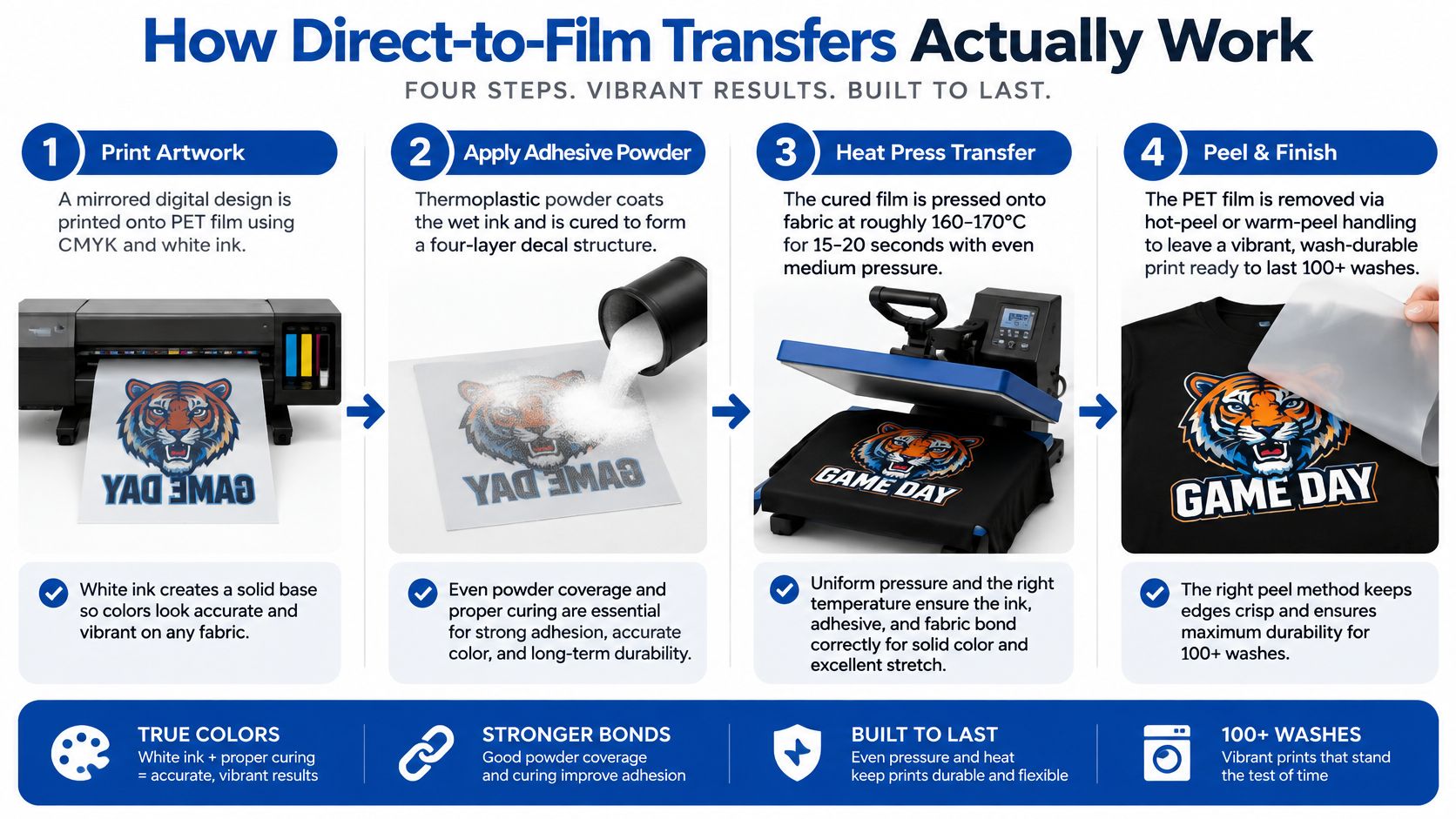
Think of a DTF transfer as a four layer decal built to fuse into fabric, not a sticker that sits on top and hopes for the best. Each layer has a job, and skipping or rushing one shows up later as peeling edges, cracking, or color that fades unevenly.
The Four Stages in Order
- Print the artwork mirrored. The design prints in reverse onto PET polyester film using pigment inks, with color first and white ink acting as the base that makes the graphic opaque on dark fabric.
- Apply adhesive powder. While the ink is still wet, thermoplastic adhesive powder coats the printed area. Excess powder comes off, so adhesive stays where the design is and not across clear film.
- Cure the powder. Heat melts the powder into a smooth adhesive layer. This stage decides much of the bond strength, because undercured powder won't grip fibers evenly during pressing.
- Press, then peel. Heat and pressure transfer the ink and adhesive stack from film to garment. With hot peel construction, you remove the film soon after pressing, which keeps a production line moving instead of forcing you to wait for every piece to cool.
A 2026 academic study describes the same sequence of printing onto PET film, applying thermoplastic powder to wet ink, curing it, and transferring with a heat press, and it reported good to excellent color fastness ratings of Grade 4 to 5 on cotton and polyester in its testing, as detailed in the 2026 study on DTF printing and wash performance. Those ratings don't happen by accident. They're the result of powder coverage, curing, and pressure working together.
Here's the part beginners miss. The film is just a carrier. Your finished print is ink plus adhesive, and its stretch, hand feel, and wash life depend on how completely that adhesive melts into the fabric surface. Pinholes, patchy powder, or a rushed cure create weak spots you won't see until the garment flexes or goes through laundry.
That's also why premium and vibrant aren't just marketing words when they're earned. A well made transfer holds fine lines and gradients because the white base is even, the colors sit in register, and the adhesive layer is uniform right out to the edge of the design.
Four Benefits That Matter on Production Day
A brand owner may reject a shade that a school coordinator would approve, while a print shop watches the cost of every transfer. Before placing an order, decide which production risk matters most: color variation, wash performance, schedule, or material use.
Color Accuracy Across Real Garments
Color problems often start in the artwork. A mismatched color profile, muddy source files, or an uneven white base can shift the result, and the garment changes how colors appear. A 2025 experimental study found cotton had lower color difference values than rayon spandex after ultraviolet exposure and washing stress. Rayon spandex shifted more, especially with bleach detergent, according to experimental research on DTF color stability by fabric type. If an order includes a stretchy blend, approve a sample on that fabric rather than relying on a color check against cotton.
Durability You Can Defend to a Customer
Lion DTF Transfers lists prices as low as $0.017 per square inch and wash testing to 100+ washes on its pricing and wash testing information page. Those figures describe tested results, not a promise that every press setting or laundry routine will produce the same outcome. Set clear care instructions and follow the transfer's pressing requirements before making a durability claim to a buyer.
Speed That Changes Your Schedule
An order shipping in 1 to 2 business days can change how you schedule a job. Rather than setting aside time to print and troubleshoot equipment, a shop can plan around receiving transfers, pressing them, and keeping a buffer before delivery. For team or event orders, that buffer may be worth more than a small reduction in material cost. Check shipping timing against your actual press capacity before promising a delivery date.
Price Per Square Inch Rewards Layout
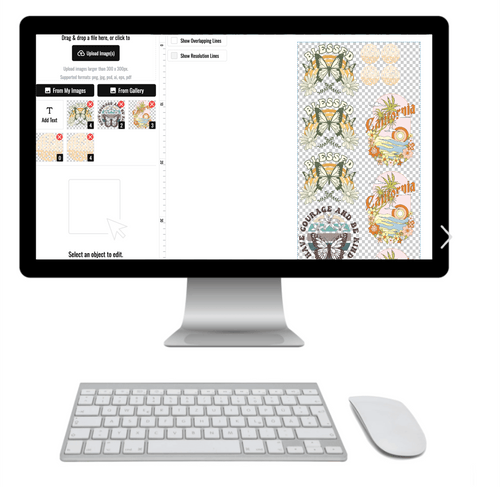
Per-square-inch pricing makes material use visible. A single small logo still occupies sheet space, while several designs arranged together can share it. The Auto-build gang sheet builder can arrange multiple designs on one sheet, reducing unused space and lowering per-unit cost when the order has enough artwork to fill the layout. Impressions Magazine reports that careful gang-sheet arrangement can achieve utilization rates above 85% in its guidance on gang sheet cost efficiency. That figure depends on design sizes and spacing, so check the finished layout before ordering.
| Priority | Who feels it most | What decides it |
|---|---|---|
| Color match | Brands, merch sellers | File quality, white base, fabric choice |
| Turnaround | Schools, teams, events | Shipping speed, press capacity |
| Unit cost | Print shops, high volume sellers | Sheet utilization, design nesting |
A low transfer price can still cost more if the order arrives late or presses inconsistently. Account for rework and missed deadlines when comparing quotes.
Matching the Right Order Format to Your Buyer Profile
The right format depends less on the design and more on how you sell. Four buyer types show up again and again, and each one wastes money in a predictable way when they order like someone else.
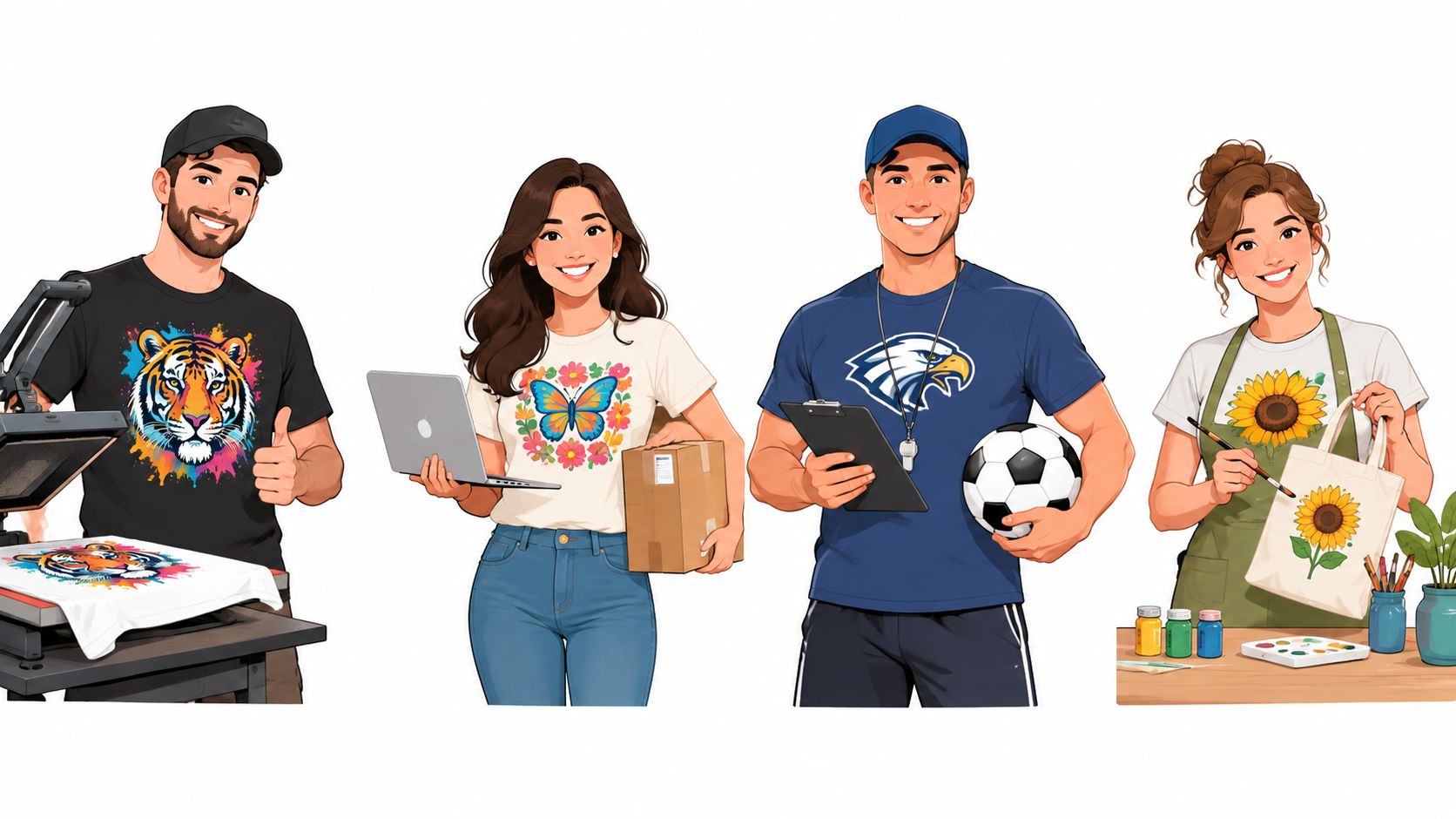
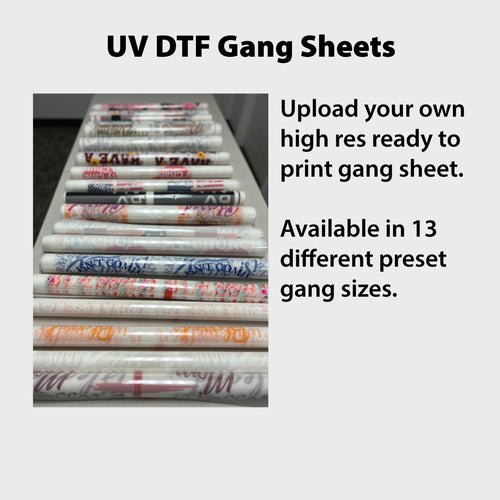
High volume print shops need predictable cost and zero surprises at the press. If you're pressing all day, order custom gang sheets and standardize your sizes. The Auto-build gang sheet builder earns its keep here because it arranges many designs onto one sheet automatically, so your staff isn't dragging files around a canvas trying to shave off empty corners. Your margin lives in that nesting.
E-commerce brands and merch sellers sell consistency. A customer who reorders a hoodie expects the same red they bought last month. Order by size for repeat best sellers so placement stays identical, keep a master file you never overwrite, and test each new blank before you list it. Your risk isn't speed. It's a review photo showing two different shades of your own logo.
Schools, Teams, and Hobby Presses
Schools and sports teams order chaos on a deadline. One sheet might hold a big front logo, small sleeve marks, names, and numbers, all needed before Friday's game. Gang sheets fit because varied graphics share one order and one shipment. Build in a few spare names and numbers on empty sheet space. Someone will misspell a roster entry, and a spare transfer costs far less than a rush reorder.
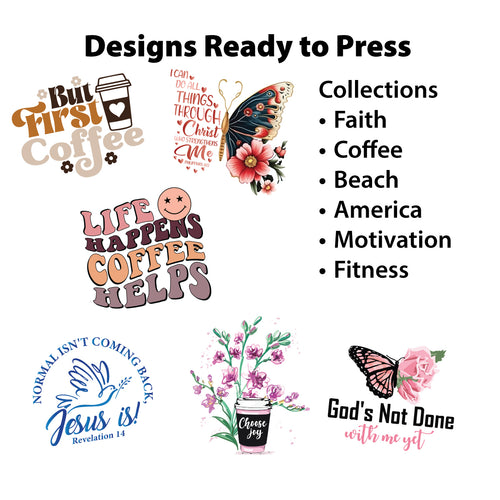
Hobby crafters with a home press should start smaller. Ready to press collections and single designs by size let you learn pressure and peel timing without committing to a huge sheet. Order a few extras of your first design. Your first press is a test, whether you plan it that way or not.
- Print shops: Gang sheets, standardized sizes, layout automation.
- Brands: DTF by size for repeatable placement and color.
- Schools and teams: Mixed gang sheets with spares built in.
- Hobby makers: Smaller ready to press designs while learning press settings.
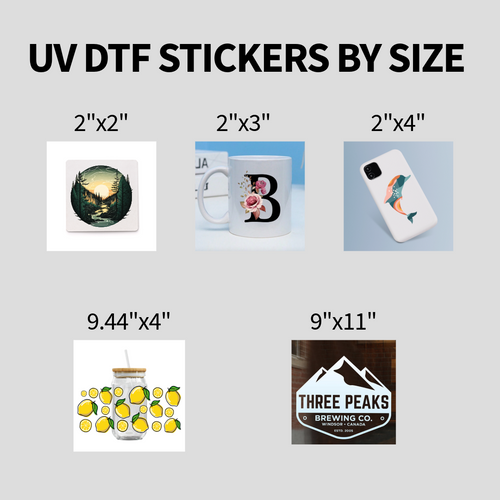
- Hard goods sellers: UV DTF stickers for cups, laptops, and packaging where fabric transfers don't belong.
Buy the format that matches how many designs, sizes, and deadlines you juggle in a normal week, not the one that looks cheapest on the product page.
Preparing Print-Ready Files and Building Your Gang Sheet
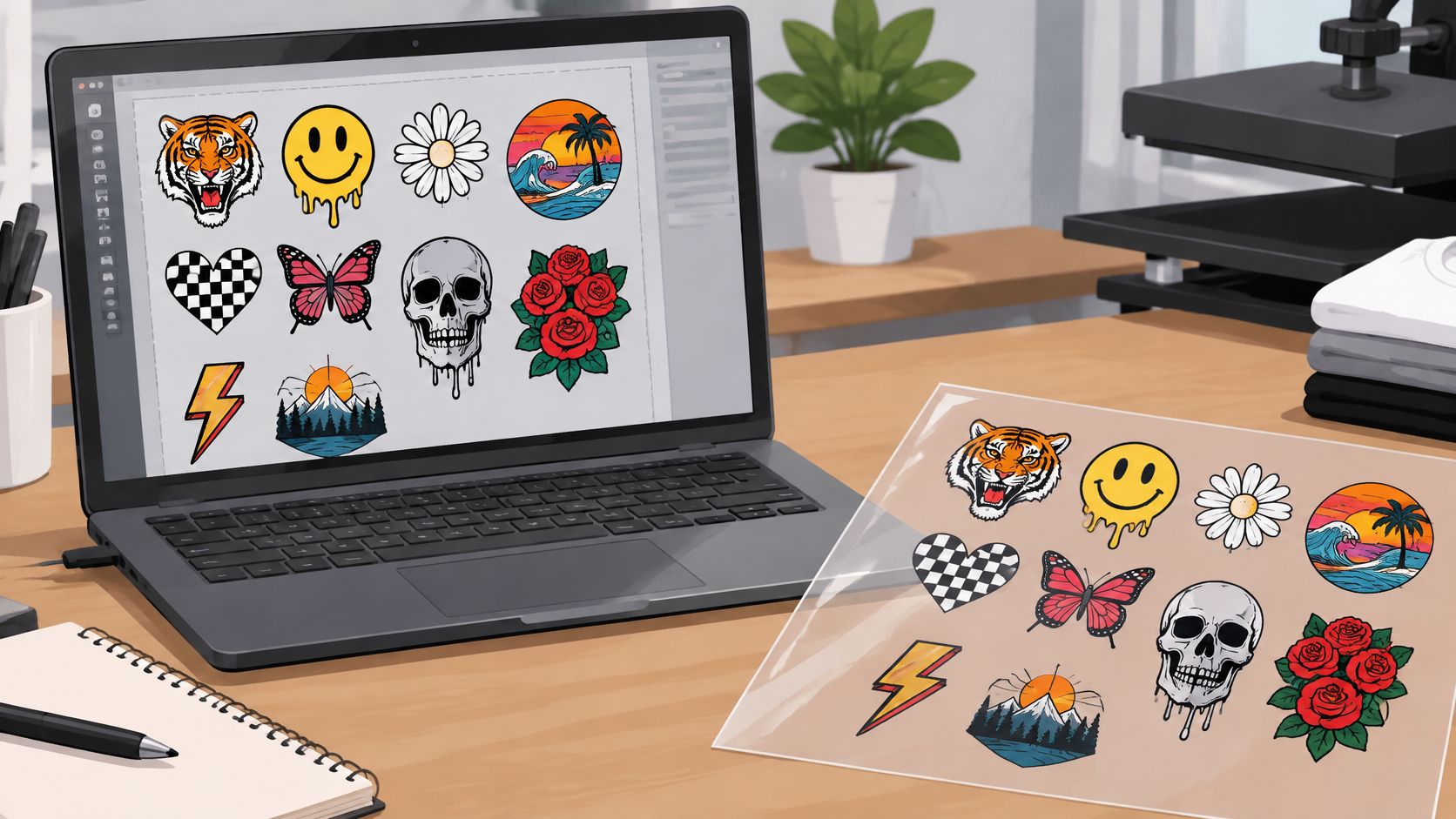
Most transfer problems are file problems wearing a disguise. A design that looks sharp in a phone screenshot can still print with fuzzy edges, a white box around it, or colors that shift the moment they're converted for print. Fix that before you upload, not after a sheet arrives.
What Print Ready Actually Means
- Resolution at final size: Export raster files at 300 DPI at the size you'll press, not at a small size you plan to stretch later.
- Transparent background: Save PNG files with transparency so only your artwork prints. Flattened white backgrounds print as white shapes.
- Clean edges: Zoom in and check for stray pixels, halos, and semi transparent fuzz. The printer will faithfully reproduce all of it.
- Sensible color choices: Build and proof with print in mind, and expect very neon screen colors to land softer on fabric.
- Vector when you have it: Logos supplied as vector files scale cleanly to any transfer size without rebuilding.
If you're planning artwork from scratch, working through custom heat transfer design guidance before you export will save you the most common rework, especially around sizing and background cleanup.
Building the Sheet Without the Manual Math
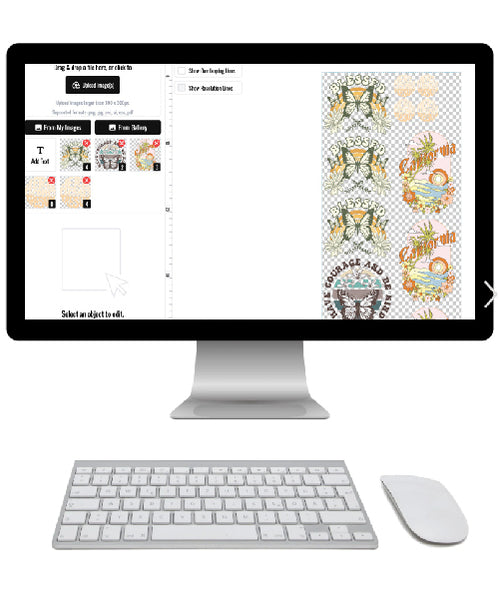
Once files are clean, layout is where money is made or lost. The Auto-build gang sheet builder takes the designs you upload, lets you set quantities and sizes, and arranges them onto a single sheet for you. You're not measuring gaps with a ruler or guessing whether one more sleeve logo fits in the corner. The builder handles spacing so each transfer can be cut apart cleanly after delivery.
That automation matters most on mixed orders. A brand running chest logos, back prints, and pocket marks in three sizes would burn real labor time nesting that by hand, and a tired operator leaves gaps. Automated nesting packs the sheet tighter and more consistently, which lowers your effective cost per design because more of the film you paid for becomes sellable product.
Before you check out: Read every name, number, and date on the sheet proof out loud. Spelling errors survive every quality process except a human actually reading them.
One last habit separates careful shops from lucky ones. Keep your approved source files, sheet layouts, and size notes together by client. When that client reorders in six months, you rebuild the exact sheet in minutes instead of starting from a screenshot in an old email thread.
Pressing, Peeling, and Caring for Finished Garments
A good transfer pressed badly fails the same way a bad transfer does. The customer doesn't care which one it was. Pressing is your half of the durability equation, and it's mostly about moisture, even pressure, and not rushing the peel.
Start with garment prep. Pre press the blank briefly to drive out moisture and smooth wrinkles, because steam pockets and creases block adhesive contact. Position the transfer, check alignment against seams rather than eyeballing the table edge, and press at approximately 160 to 170°C for 15 to 20 seconds with even medium pressure, the controlled application range identified in the technical guide to how DTF transfers are made and applied.
Pressure deserves more respect than temperature. An independent textile study using household laundering conditions found DTF samples retained strong visual integrity through approximately 15 to 20 washes, while uneven pressure from an iron based transfer produced greater localized color loss, as reported in the independent textile study comparing image printing methods. A calibrated heat press spreads force across the full design. A household iron concentrates it wherever your hand happens to push.
Peel Timing and the Second Press
With hot peel transfers, remove the film smoothly soon after the press opens, in one steady motion rather than short tugs. If an edge lifts, lay the film back down and press again instead of forcing it. A brief second press after peeling, with a protective sheet, settles the print into the fabric texture and improves the finished hand feel.
Care Instructions to Pass to Your Customer
- Turn inside out before washing to reduce abrasion on the print surface.
- Wash cold with mild detergent and skip bleach and fabric softeners.
- Tumble low or air dry instead of blasting the garment with high heat.
Those habits aren't fussy extras. Technical testing found quality DTF garments can withstand approximately 50 wash cycles, with black prints remaining visually fresh after about 52 washes under recommended care, according to the technical report on DTF durability and curing conditions. For a fuller explanation you can share with buyers, point them to how long DTF transfers last under normal care. Print the care steps on a hang tag. Customers follow instructions they can find.
Pricing Examples and Turnaround Options That Fit Your Deadline
Per square inch pricing looks abstract until you run your own sizes through it. The math is simple. Multiply width by length to get square inches, then apply the rate. What changes your real cost isn't the arithmetic. It's how much of that area becomes finished, sellable transfers.
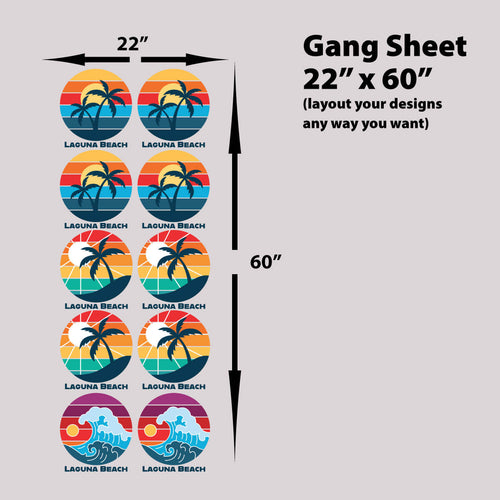
Take a single full chest logo on a 12 by 12 inch cut. That's one design carrying the whole sheet area, which makes sense for a one off or a sample. Now compare a 22 by 24 inch gang sheet holding ten designs in mixed sizes. The sheet costs more overall, but each logo carries only its share of the area, so your cost per pressed garment drops sharply. A large 22 by 60 inch sheet pushes that logic further for high volume runs, provided you have enough designs to fill it.
That's the catch. A big sheet you half fill is worse than a smaller sheet packed well. Use the Auto-build gang sheet builder to test layouts before you commit, and add spare logos, size variants, or upcoming repeat orders to fill honest gaps instead of paying for blank film.
Matching Speed to the Actual Deadline
- Standard shipping in 1 to 2 business days: Right for weekly e-commerce restocks and planned shop work.
- 24 hour printing: Fits event merch and team orders where the date won't move.
- Same day pickup: Best when you're local and the press is already warm.
- Next day air: Insurance for spirit week, tournaments, and client launches, priced like insurance.
Don't buy the fastest tier by habit. If your blanks won't arrive until Thursday, paying to have transfers in hand Tuesday buys you nothing. Work backward from the day garments must be worn, subtract your pressing and packing time, then choose the slowest shipping option that still leaves a one day buffer. That buffer, not the rush fee, is what saves the job when a roster changes.
Estimate every quote the same way. Sheet cost divided by usable designs, plus blank, plus your press labor. Sixty seconds of that math beats discovering your margin after you've shipped.
Support Services That Turn a Vendor Into a Production Partner
Printed film is the easy part to compare. What keeps a shop with one supplier is what happens when a file is wrong, a color won't match, or a deadline moves. That's where support services stop being perks and start being production tools.
Vectorization rescues the low resolution logo a client pulled from their own website, rebuilding it into clean artwork that scales without fuzzy edges. The We Build a Gang Sheet for You service hands layout to people who nest sheets daily, useful when your team is slammed or you're still learning efficient spacing. The Auto-build gang sheet builder covers the middle ground, automating layout when you want control without the manual work.
Color matching guidance matters when a brand client holds last season's shirt next to your new press. So does being able to reach a person. Support is available by phone, text, email at info@liondtf.com, and website chat at 949-229-1164, backed by thousands of verified 5-star reviews that signal consistency across many orders, not one good week. If you're still comparing suppliers, the criteria in how to choose a reliable DTF transfer supplier in the US give you a practical checklist beyond price.
Pick your next step based on your bottleneck. Bad artwork goes to vectorization. Crowded layouts go to the builder. A first order should be small, pressed on your actual blanks, and washed before you promise it to anyone.
Start with one real job, build it on a gang sheet, and press it on the blanks you sell, then judge the color, peel, and wash result for yourself. Lion DTF Transfers offers ready to press DTF transfers, gang sheets built for efficient layout, and support services like vectorization when your artwork needs help. Upload your files, build your first sheet, and put a transfer through your own press this week.
Email orders@LionDTF.com or Text or Call: 833-350-5466