


You've got a Fresno school fundraiser, team order, merch drop, or customer deadline on the calendar, and the artwork is ready, but the printing method still isn't clear. Screen printing may involve too much setup for a short run, vinyl can turn detailed artwork into a weeding project, and DTG may not suit every garment or production schedule. DTF Fresno businesses use direct-to-film transfers to fill that practical middle ground, combining full-color artwork, fabric flexibility, and a workflow that works for both production shops and home heat presses.
Fresno is a natural market for that flexibility. The city was founded in 1872 by the Central Pacific Railroad Company, and its early growth was tied to transportation and agriculture. Fresno later reached 494,665 residents in 2010 and 542,107 in 2020, making it California's fifth-most populous city and the United States' 33rd-most populous city, according to the City of Fresno community information. Around it, Fresno County supports a major agricultural economy, with 1.88 million acres of farmland, more than 350 crops, and $9,029,122,000 in agricultural production value in 2024, as documented in the Fresno County annual crop and livestock report. That mix of businesses, crews, schools, growers, creators, and event organizers creates constant demand for practical custom apparel.
What DTF Printing Means for Fresno Businesses
A local shop owner receives a request for detailed employee shirts, a few branded totes, and several garment colors, all needed quickly. The artwork includes gradients, small lettering, and a logo that must look consistent across cotton, polyester, and blended fabrics. Burning screens would add setup, vinyl would add weeding, and pretreating garments for DTG would complicate the schedule.
Direct-to-film printing, or DTF, starts with a digital file. A printer applies water-based ink to a coated PET film, usually with a white-ink layer supporting the color artwork. Adhesive powder is applied to the wet print, then the transfer is cured before it reaches the heat press. The operator positions the finished transfer on the garment and uses heat and pressure to bond it to the fabric.

Why the workflow matters
DTF removes several preparation stages that slow other decoration methods. There's no screen burning, no vinyl weeding, and no garment pretreatment at the pressing stage. That makes it accessible to a commercial print shop, an online seller outsourcing transfers, or a crafter working with a small heat press at home.
The film also needs to be engineered carefully. A commonly specified DTF construction uses a PET base around 75 ± 5 micrometers, total film thickness near 89 ± 5 micrometers, and basis weight around 115 ± 10 grams per square meter, according to this DTF transfer film specification sheet.pdf). Those dimensions help balance print stability, ink and powder handling, curl control, and reliable feeding.
Practical rule: DTF is only as efficient as the complete workflow. A good file, stable film, properly cured powder, and a controlled press matter as much as the printer itself.
For Fresno businesses, the appeal is less about novelty and more about control. A seller can test a design without committing to a large inventory, a team can decorate mixed garment fabrics, and a shop can handle detailed color artwork without preparing a separate screen for every color. The California DTF printing overview provides additional context for how the method fits regional apparel production.
How DTF Compares to DTG, Screen Printing, and Heat Transfer Vinyl
The right decoration method depends on the order, not on which technology sounds most advanced. A short run of full-color logos has different needs from a large order of simple one-color shirts. Fabric, artwork, quantity, labor, and deadline all change the calculation.
| Method | Best For | Min Order | Fabric Range | Turnaround |
|---|---|---|---|---|
| DTF | Short runs, detailed full-color graphics, mixed fabrics | Small or flexible runs | Broad range, including cotton, polyester, and blends | Fast once transfers are ready |
| DTG | Detailed artwork printed directly onto suitable garments | Small runs | Best on compatible cotton-focused garments | Depends on pretreatment, printing, and curing |
| Screen printing | Larger runs with simple artwork and strong repeatability | More practical at higher quantities | Works well on common apparel fabrics | Setup takes time, production becomes efficient at scale |
| Heat transfer vinyl | Names, numbers, simple shapes, and limited-color designs | Small or one-off jobs | Many common garments | Fast for simple designs, slower when weeding is complex |
DTF usually makes the strongest case when the design has multiple colors, photographic detail, or fine edges and the order doesn't justify screen setup. It also handles fabric variety more comfortably than DTG, especially when a buyer needs both light and dark garments or a blend rather than a carefully selected cotton blank.
Screen printing can still win for a larger, repeatable order with uncomplicated artwork. Once screens are prepared, the process can be efficient and the hand feel may suit the brand better. DTF isn't automatically cheaper in every scenario, especially when a large order uses few colors and one garment style.
Heat transfer vinyl remains useful for athletic names, jersey numbers, simple lettering, and designs that benefit from a solid cut surface. The problem appears when the artwork contains many small elements. Every shape that must be cut, separated, and weeded adds handling time.
DTG offers direct garment printing without a transfer film, but pretreatment and curing remain important parts of the workflow. The DTF and DTG comparison is useful when you're deciding whether the transfer stage is an advantage or an unnecessary step for a particular garment program.
Choose DTF for flexibility and detail. Choose screen printing for scale and repeat simplicity. Choose vinyl for straightforward personalization. Choose DTG when direct-to-garment production and compatible blanks fit the job.
Preparing Your Files and Building Gang Sheets
Most DTF problems begin before printing. A low-resolution file, flattened background, or poorly prepared edge can produce a transfer that presses exactly as submitted, including jagged lettering or an unwanted box around the design.
Start with artwork that has a transparent background and a file format your printer can use, such as PNG, SVG, or PDF. Raster artwork should be prepared at 300 DPI, and CMYK color mode is generally the practical choice for digital transfer workflows. Keep small text and narrow strokes large enough to survive printing, powder application, peeling, and pressing.

A workable ordering sequence
- Inspect the artwork. Open the file against a contrasting background. Check transparency, spelling, thin outlines, and whether the intended print size matches the garment.
- Measure the finished transfer. A design that looks acceptable on a monitor may overwhelm a small chest area. Size the artwork for the actual garment location before placing it on a sheet.
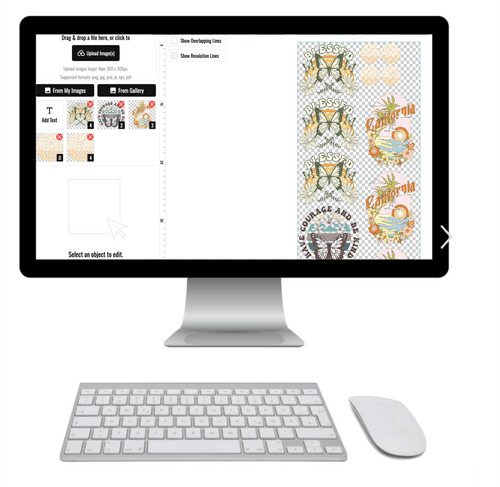
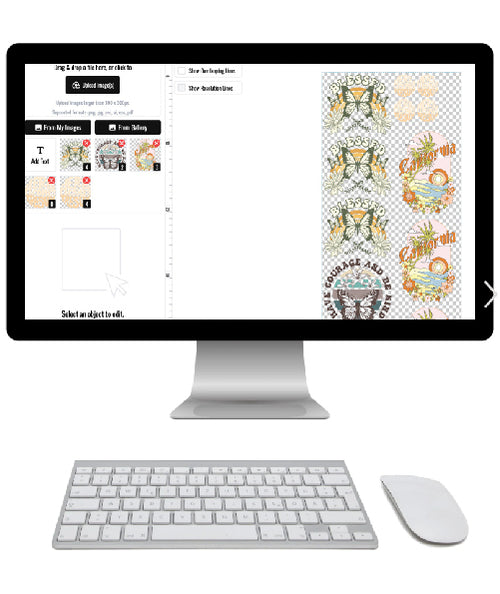
- Use the Auto-build gang sheet builder. Upload the designs and let the builder arrange them efficiently on one film sheet. This is the easiest route for buyers who have several logos, sizes, or seasonal graphics and don't want to calculate spacing manually.
- Review the layout before checkout. Make sure designs aren't touching, important details aren't too close to the edge, and the sheet contains every variation you need.
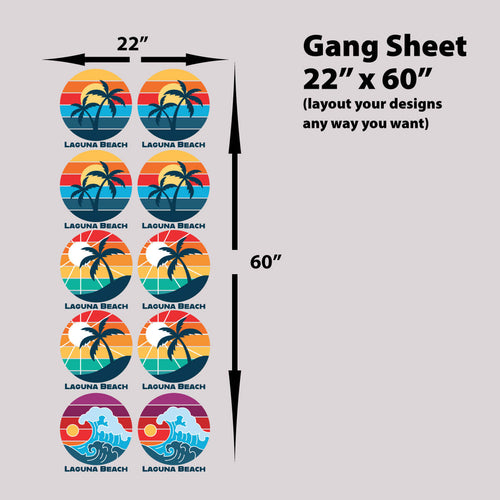
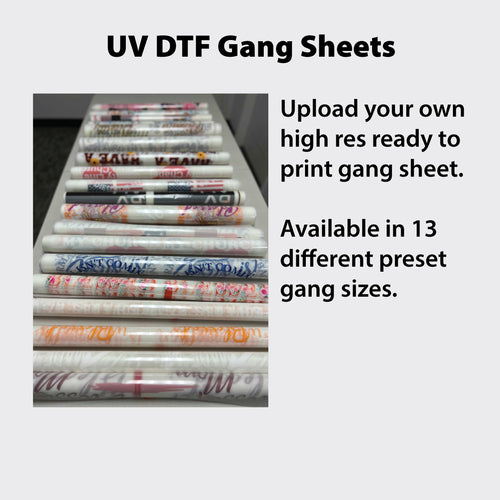
Gang sheets are cost effective because you're buying usable film area rather than ordering each small transfer as a separate item. Industry ordering systems commonly distinguish between uploading a fully arranged print-ready sheet and using a builder to place multiple designs, so the Auto-build gang sheet builder is a standard production convenience, not a gimmick. The DTF gang sheet guide explains how that workflow supports mixed designs on one sheet.
Public catalogs show standardized choices such as 22 by 24 inches, 22 by 36 inches, 22 by 60 inches, and 22 by 120 inches, with some listings extending to 22 by 250 inches, as shown by this custom transfer size catalog. Pricing commonly improves as the sheet gets longer. One public price list shows 22 by 24 inches at $8.99 and 22 by 500 inches at $185.99, while another lists longer sheets at $0.025 per square inch, according to this gang-sheet pricing reference.
Cost-control habit: Fill the sheet with designs you'll actually press. Empty space is only economical if it prevents a future order or supports a planned product run.
Local Fulfillment Options and Turnaround Times
A Fresno buyer should start with the deadline and work backward. An event order that must be pressed tomorrow needs a different fulfillment choice from a merch restock that can travel with a normal shipment. The relevant questions are the quantity, the destination, the transfer readiness, and whether pickup is practical.
Lion DTF Transfers offers several paths for buyers who need speed, including same-day pickup where available, next-day air shipping, and standard one to two business day production and shipping options, as described by the provider. Same-day pickup can make sense for a local shop that already has blanks and a press ready to run. It avoids waiting for a carrier, but it only helps if the buyer can reach the pickup location and the order is accepted within the available production window.
Next-day air is more useful when the order must move outside the immediate area or when a local pickup isn't workable. It costs more than ordinary shipping, so reserve it for a deadline that justifies the premium. Standard shipping is the sensible choice for planned inventory, repeat programs, and gang sheets ordered before the rush.
Color consistency deserves its own checkpoint. Ask how the provider handles color matching, white ink, film, powder, curing, and reprints. If a Fresno team orders uniforms in stages, the buyer should keep the original artwork, intended garment color, and placement specifications so later batches can be compared against the first run.
Deadline rule: Ask for the production cutoff, not just the shipping promise. A carrier service can't recover time lost while artwork waits for approval.
Reliability also includes the press operator's side. Two garments can receive the same transfer and look different if one press has uneven pressure, the platen isn't level, or the operator changes temperature and dwell time. A dependable fulfillment plan therefore includes a proof or test press for important brand marks, especially when several garment materials are involved.
The broader DTF market is growing, but local buyers still need to evaluate real logistics rather than rely on general enthusiasm. A commercial report estimates the market at USD 2.68 billion in 2025, USD 2.85 billion in 2026, and projects USD 4.25 billion by 2032 at a 6.77% CAGR, as reported by this DTF printer market report. Those figures describe the global segment, not a Fresno turnaround guarantee.
Pressing Instructions and Wash Care for Long-Lasting Prints
A transfer can be printed perfectly and still fail on the garment if the press doesn't deliver consistent heat and pressure. Start with a clean, dry garment. Pre-press briefly to remove moisture and wrinkles, place the transfer with the printed side facing the fabric, and cover it with the recommended protective sheet.
For a common starting point, press at 270°F, for 10 seconds with medium-firm pressure, as shown in the required pressing guidance below. Fabric, transfer construction, and press type can change the ideal setting, so test an unfamiliar blank before committing to a full order.

Pressing checklist
- Prepare the blank: Remove lint, smooth seams away from the print area, and pre-press to reduce moisture.
- Position accurately: Confirm the centerline, vertical placement, and orientation before closing the press.
- Apply even pressure: Keep the garment flat and use a protective cover that won't interfere with bonding.
- Peel correctly: Follow the transfer supplier's hot-peel or warm-peel direction. Pull steadily rather than lifting corners aggressively.
- Finish the surface: A short second press through protective paper can help secure edges when the transfer instructions call for it.
Don't judge adhesion by appearance alone. Let the garment cool and inspect the edges, narrow lines, and corners. If an edge lifts, the problem may be insufficient pressure, uneven heat, moisture, contamination, or incorrect peeling.
The wash routine protects the bond after pressing. Turn the garment inside out, wash it in cold water on a gentle cycle, and hang dry or tumble dry on low heat. Never iron directly over the printed design, because direct heat can distort or damage the surface.
Independent and industry-published durability discussions commonly place properly cured and pressed DTF prints around 80 to 100 wash cycles before visible degradation, with durability guidance from a screen-printing community discussion. Treat that as a benchmark, not a promise. Adhesion failure and cracking usually reflect pressing errors or harsh wash care more than the transfer chemistry by itself.
The following video provides a visual reference for pressing and garment care:
Real-World Use Cases for Fresno Shops, Teams, and Crafters
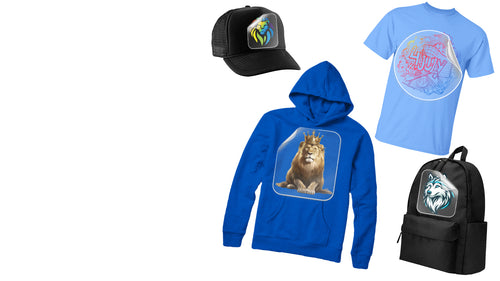
A Fresno print shop may receive a run that mixes company polos, cotton tees, performance shirts, and tote bags. DTF lets the operator use one detailed digital design across that assortment, then press each item according to the blank and transfer requirements. The shop avoids creating screens for a short, mixed order and can keep the production conversation focused on artwork, sizing, and placement.

A sports team can order names, numbers, and a detailed crest without stocking decorated garments in advance. That helps when players need different sizes or when a roster changes close to a tournament. The buyer should still test the actual performance fabric, because stretch, texture, and heat sensitivity affect the pressing result.
Schools and event organizers often need designs tied to a specific activity, fundraiser, or graduating group. A gang sheet can combine adult and youth artwork, staff versions, sponsor marks, and small accessories without forcing every design into a separate order.
Smaller operators benefit from the same flexibility
An e-commerce seller can test a limited design, press only sold garments, and avoid committing to a large screen-printed inventory. A crafter can order personalized graphics and apply them at home, provided the press delivers stable temperature and pressure across the design.
For every use case, the decision should account for garment type, design detail, quantity, and deadline. DTF is especially practical when those variables change from order to order. It isn't a substitute for every method, but it gives Fresno-area businesses a capable option when flexibility matters more than a highly standardized production run.
Getting Started with Lion DTF Transfers
A first order doesn't need to be complicated. Prepare the artwork, decide the finished transfer dimensions, identify the garment fabrics, and estimate how many versions you need. If the artwork isn't ready, support may include logo design, vectorization, and a “We Build a Gang Sheet for You” service.
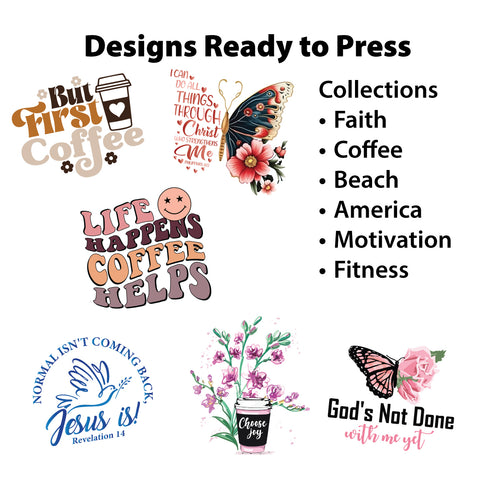
For buyers who need designs quickly, ready-to-press collections cover themes such as America, faith, coffee, and seasonal holidays. Those collections can be useful when the deadline is closer than the design process, while custom uploads remain the better route for brand marks and original artwork.
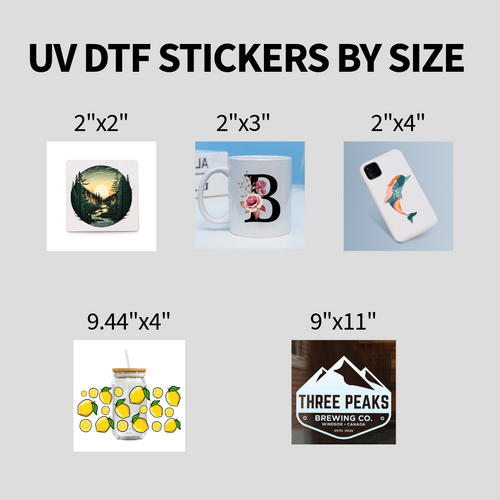
Lion DTF Transfers provides custom transfers by size, gang sheets, and an Auto-build gang sheet builder for arranging multiple designs efficiently. The provider also lists pressing and UV sticker instructions, supplies, and blanks, so a buyer can plan more than the transfer alone. Support is available by call, text, email at orders@liondtf.com, phone at 833-350-5466, and website chat.
Thousands of verified 5-star reviews and responsive support are useful trust signals, but the practical test is still the same: submit clear artwork, confirm the size and fabric, approve the layout, and test-press a new combination. That process gives a Fresno shop or crafter a repeatable way to move from idea to finished garment.
Lion DTF Transfers offers custom DTF transfers, gang sheets, ready-to-press designs, and an Auto-build gang sheet builder for Fresno businesses, teams, sellers, and home crafters. Visit Lion DTF Transfers to upload your artwork, build a cost-conscious sheet, or get help with design preparation and fulfillment for your next print run.
Email orders@LionDTF.com or Text or Call: 833-350-5466