



You've got a stack of mixed orders on the bench, a heat press heating up, and a Friday deadline that isn't waiting for screens, weeding, or guesswork. That's where a lions transfer workflow starts to matter, because the job is rarely about one perfect shirt. It's about getting a clean print, on time, at a cost that still leaves margin.
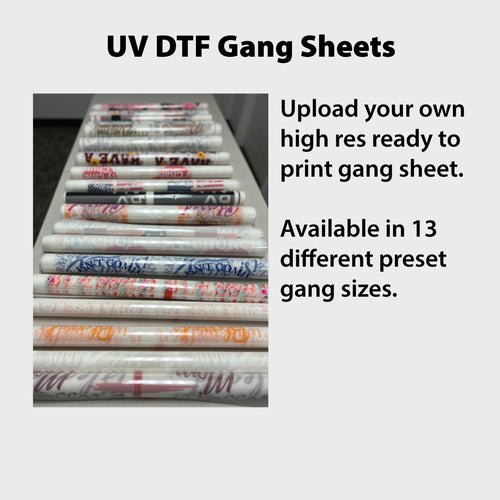
Lion DTF transfers, in practice, sit in the lane built for that kind of work. They cover hot-peel DTF transfers, gang sheets, and UV DTF stickers, which means the buyer can match the product to the actual job instead of forcing every order through the same process. For small shops, that difference is the gap between making the week and drowning in setup.
Why Lion DTF Transfers Has Become a Go-To for Small Apparel Runs
Monday morning in a small print shop usually looks the same. There's a school order with mixed sizes, a merch drop with three colors, two rush jobs from a promo buyer, and no appetite for burning screens that won't pay back on a tiny run. That's the kind of situation where specialty transfer buying makes more sense than trying to force everything in-house.
The business logic behind the buy
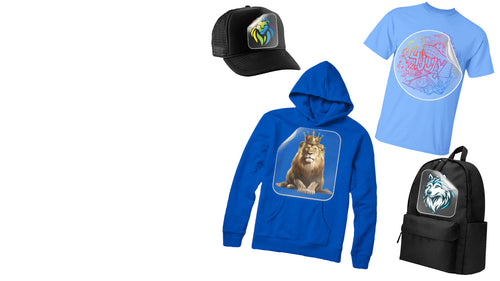
A lions transfer setup is built for short, mixed, and on-demand work. That matters because translocation in conservation works only when the environment can support the move, and the same logic applies here, the print method only works when the job fits the method. For apparel, the practical fit is clear, hot-peel transfers for garment decoration, gang sheets for mixed artwork, and UV DTF stickers for hard surfaces like drinkware and signage.
Practical rule: if a job needs speed, variety, and low setup friction, the transfer model usually beats a process that asks you to build a whole production line around one order.
Small operators also value turnaround. A provider that can move fast with same-day printing, next-day air, and quick pickup options gives the buyer a way to quote the job with confidence instead of padding the schedule for setup risk. That's not hype, it's just how busy shops keep promises when the calendar gets crowded.
What sits under the umbrella
Think of the product family like tools in a drawer. Apparel transfers handle shirts and hoodies, gang sheets help you nest multiple designs into one print run, and UV stickers cover rigid surfaces where fabric methods don't belong. The point isn't that one is “better,” it's that each one solves a different production problem.
The useful question is simple, what am I decorating, how many pieces are there, and how much setup can I afford? For a small shop, that question usually decides whether the job stays profitable.
What a DTF Transfer Is
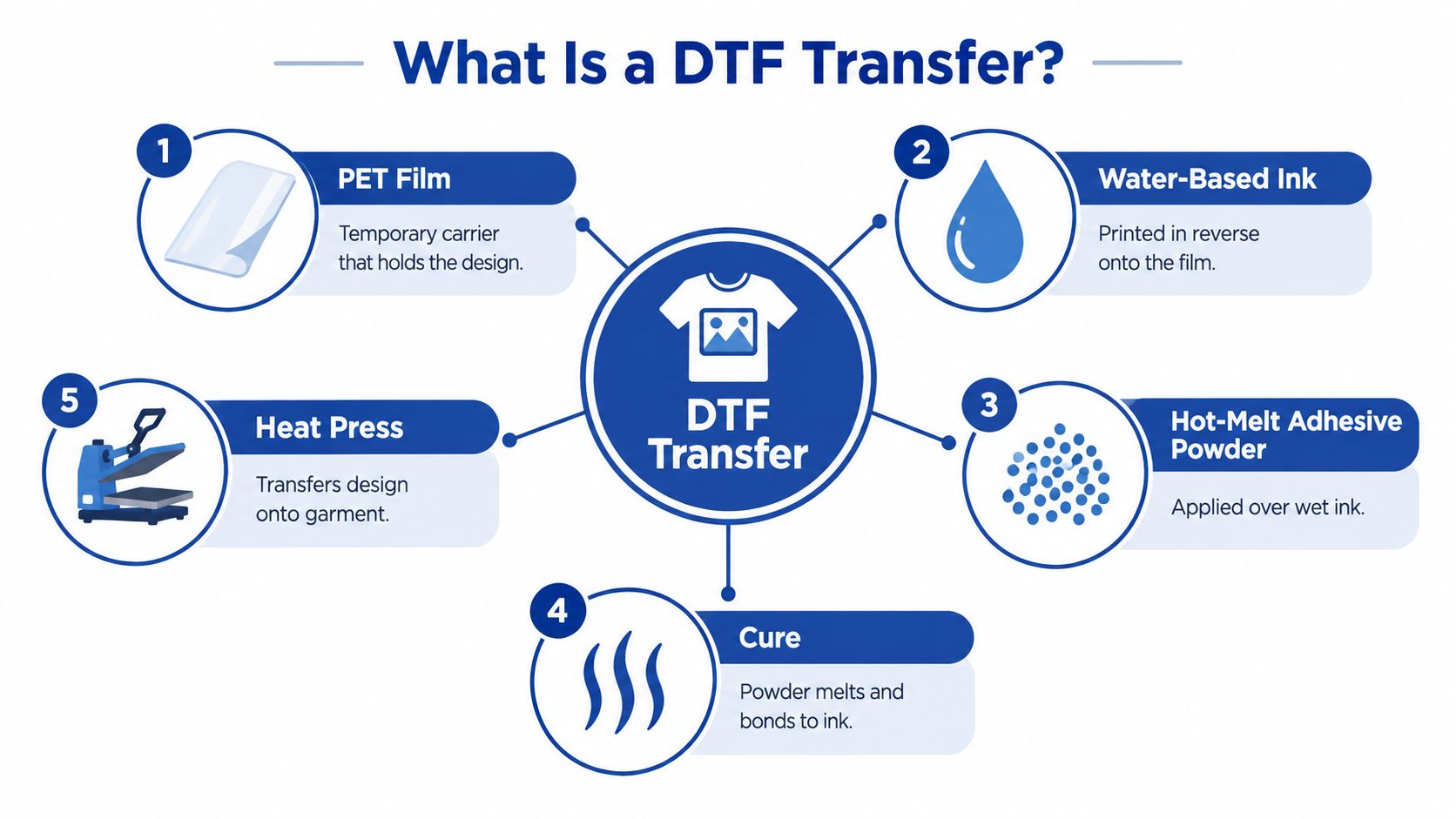
A DTF transfer is the finished transfer stack before it ever hits the shirt. In shop terms, it starts as artwork printed onto PET film, gets coated with hot-melt adhesive powder, gets cured, and then moves to the garment under heat and pressure. If you want the step-by-step version, see our guide on what a DTF transfer is. That stack is what decides whether a print presses fast, holds up, and stays profitable instead of turning into a reprint.
The stack that makes the print work
Each layer has a job. The film is only the carrier. The ink builds the image and opacity. The powder creates the bond. Curing melts that powder into the ink layer so the press can attach it cleanly to the fabric surface.
That construction is why DTF fits jobs that other methods handle less efficiently. Screen printing still makes sense when the order has enough repeat volume to justify setup. DTG works best in a printer-direct workflow with the right garment. Sublimation favors polyester and light substrates. HTV can solve simple jobs, but it adds labor on full-color art. DTF gives a shop one transfer format that can cover cotton, polyester, and blends without forcing a new setup for every order.
That matters on the clock and on the invoice. If the transfer arrives ready, the operator spends time pressing shirts, not rebuilding art into a slower production method. If the sheet is packed well, the cost per logo drops. If the peel, cure, or adhesive is off, that “cheap” transfer gets expensive fast.
Why durability is a system issue
A DTF print lasts because the whole stack was built and pressed correctly. Research on wash performance reports broadly about 70 to 100 washes when film, adhesive, curing, and press settings are dialed in, and separate durability guidance says a properly made print can last at least 50 washes with proper care (wash-performance research).
Good artwork alone does not save a bad transfer.
For buyers, the takeaway is simple. Judge the transfer as a production system, not just a graphic on film. When the materials, cure, press settings, and wash care line up, the print holds up and the job keeps its margin.
Hot-Peel Transfers, Gang Sheets, and UV Stickers Compared
The easiest way to choose a product is to match it to the job in front of you. A hot-peel transfer is the everyday apparel choice. A gang sheet is a cost-control tool for mixed art and small batches. UV DTF stickers are for hard goods, not fabric, so they belong on tumblers, mugs, and signage.
Choosing the right product
| Product | Best For | Typical Buyer | Cost Shape |
|---|---|---|---|
| Hot-Peel Transfers | Single designs, shirts, hoodies, quick apparel orders | Small shops, brands, rush buyers | Straightforward per-piece pricing |
| Gang Sheets | Multiple designs in one print run, small mixed batches, team and promo work | Print shops, schools, e-commerce sellers | Lower per-transfer cost when the sheet is packed efficiently |
| UV DTF Stickers | Rigid surfaces, drinkware, labels, signage | Merch sellers, promo companies, creators | Cost follows sheet use and application area |
Hot-peel apparel transfers are the most familiar format if you're pressing garments all day. They're efficient when the artwork is ready and the order is simple. Gang sheets are different, because they let you combine designs, sizes, and color variations on one sheet, which cuts down on repeated handling.
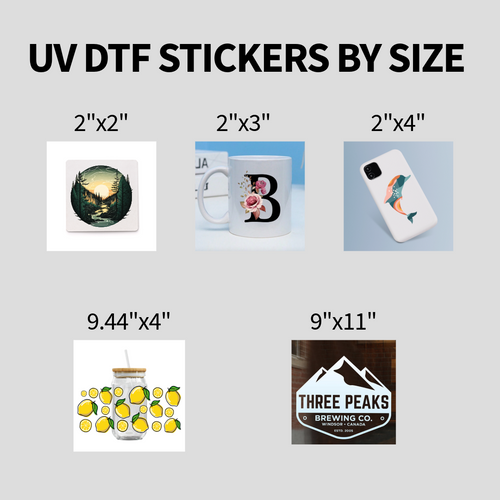
UV DTF stickers solve a different problem altogether. They're not the choice for fabric, and that's the point. If the order is for a tumbler bar set, office signage, or a hard-surface promo item, a sticker format is the right tool.
Where the auto layout helps
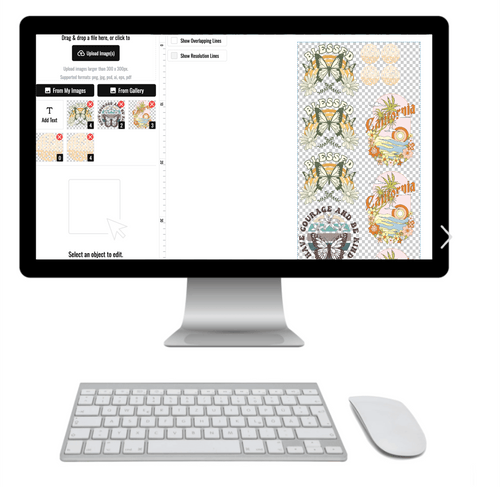
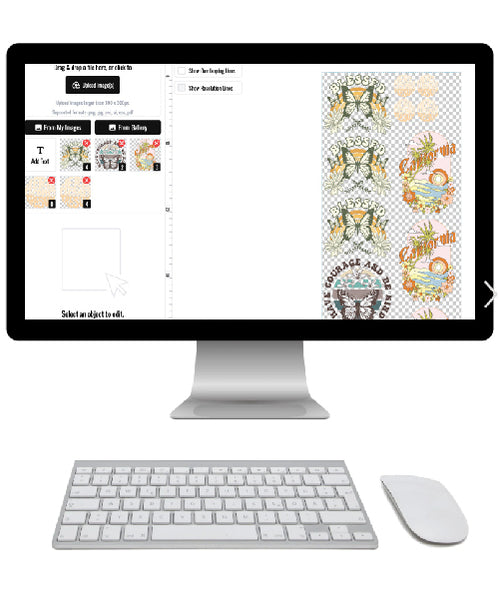
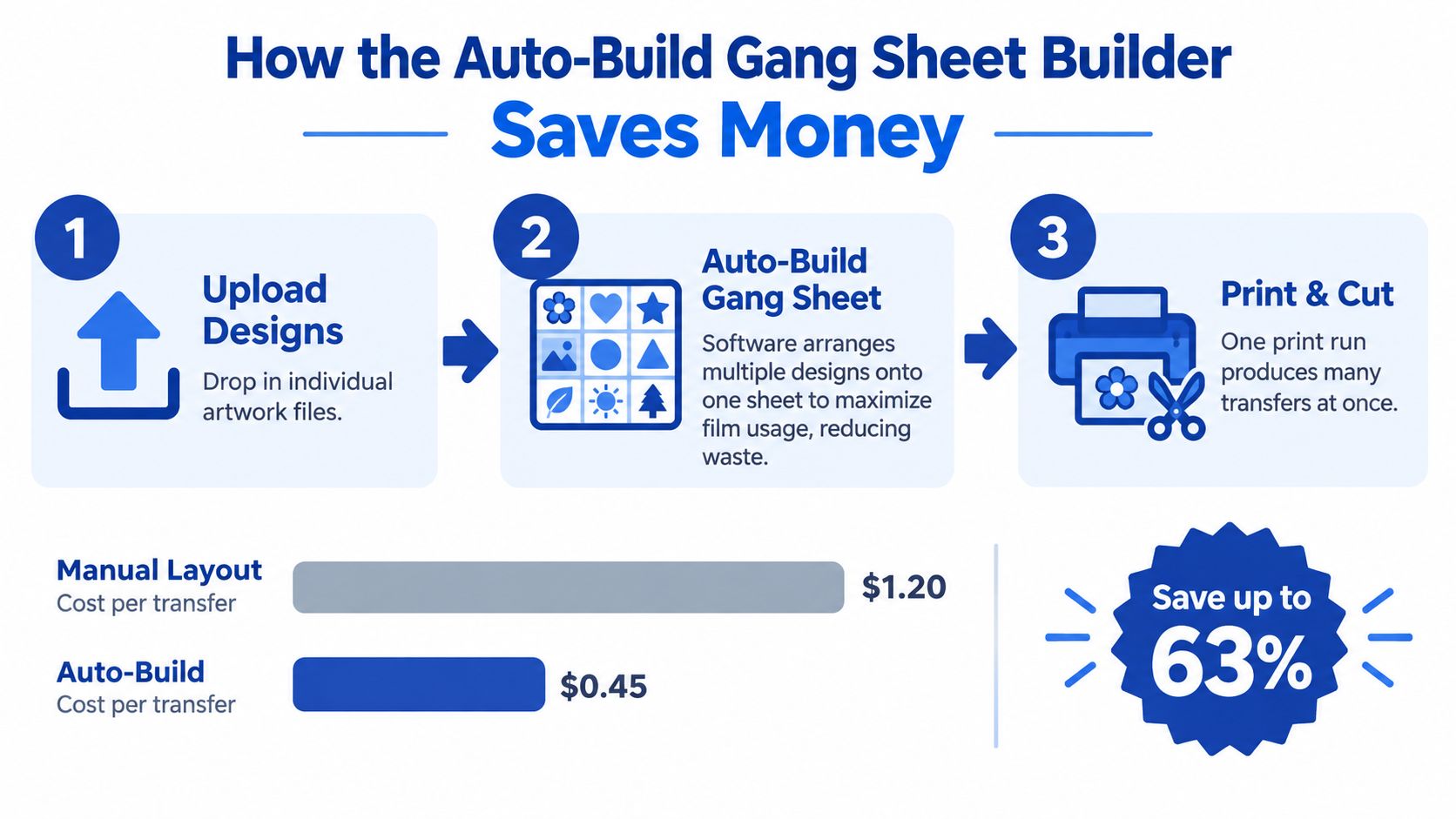
The easiest path for mixed art is the Auto-build gang sheet builder. Instead of laying out every logo by hand, the buyer uploads the files and lets the sheet get arranged more efficiently. That saves time, and in a shop, time is money just as much as film is.
Practical rule: don't choose the format by habit. Choose it by substrate, order size, and how much manual setup you're willing to pay for.
How the Auto-Build Gang Sheet Builder Saves Money
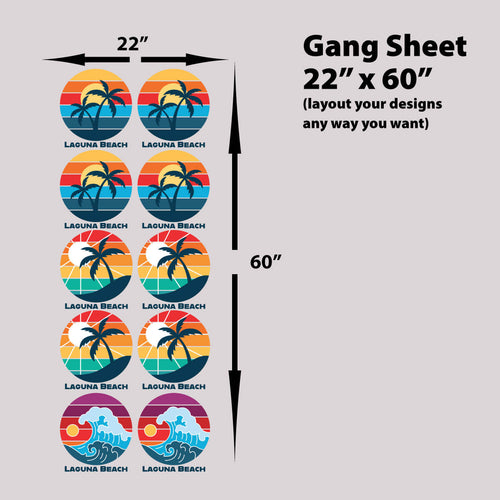
A gang sheet saves money only when the sheet is packed well. The printer, powdering stage, and film handling happen once per sheet, so a page that is 95% full costs little more to produce than one that is 30% full. Empty space is not free, it is wasted film and wasted margin.
The savings come from nesting, not luck
One industry guide gives a simple example, fitting 10 chest logos on a fixed length of film produces an implied cost of $0.50 per logo, while fitting 20 on the same length cuts that to $0.25 per logo (gang-sheet economics). Another guide says a well-packed gang sheet can reduce per-transfer film cost by roughly 30 to 50% compared with printing one design at a time (cost comparison).
That is the part many new buyers miss. You are not just paying for print time, you are paying for how efficiently the sheet gets used. The tighter the nest, the less film gets tossed as dead space, and the less each logo costs.
How to use the builder well
The Auto-build gang sheet builder removes most of the manual layout work. Upload the artwork, let the system arrange the sheet, and keep the spacing tight enough to stay efficient without letting designs touch during cutting or handling. A practical spacing target is about 0.25 to 0.5 inches between designs, which gives the cutter room and keeps the sheet workable.
That spacing matters because loose layout burns film. Too tight, and handling gets messy. The builder helps keep the job in the middle, where the sheet is dense enough to save money and still clean to press.
It also saves layout minutes per order. At a steady order flow, those minutes become labor cost, the same way wasted film does.
Why small shops feel the difference fastest
For a school order with ten names, a mixed merch drop, or a promo job with several logos, gang-sheet packing decides the margin. Better nesting means fewer sheets, less wasted film, and fewer repeat prints. The Auto-build gang sheet builder keeps that cost-control step consistent, which matters when every shirt and every minute has to pay for itself.
Pressing and Curing the Transfer the Right Way
Most DTF problems show up at the press, not in the artwork. The fix is to treat pressing like a sequence, not a vibe. If you change the order or skip a step, the bond is the first thing to suffer.
A reliable sequence on the press
Start by pre-pressing the garment to push out moisture and wrinkles. The checklist commonly used for DTF work calls for 3 to 5 seconds of pre-pressing, then placing the film ink-side down, and pressing at about 240-280°F with medium pressure for 7 to 10 seconds before peeling according to the transfer's peel type.
Practical rule: moisture is the silent failure. If the shirt is damp, the bond doesn't start cleanly.
After the press, peel as directed, hot or warm for the film system you're using. If the release step is wrong, edge lift shows up first. If the press temperature is off, adhesion gets patchy. If the cure was weak, the print may look fine for a moment and then start breaking down after wear and wash.
The failure modes worth watching
Under-cure usually shows up as peeling or weak adhesion. Overheating can distort the garment or make the transfer feel harsh. Peeling too aggressively can lift corners. Skipping the pre-press traps moisture, and moisture can undermine the bond even when everything else looks right.
A simple bench checklist helps:
- Pre-press first: remove moisture before positioning anything.
- Set the press correctly: use the film's temperature and time, not a guess.
- Follow the peel method: hot, warm, or cold depending on the transfer.
- Check the edges: look for lift before the shirt leaves the table.
- Second press if needed: a light post-press can improve finish and feel.
For a deeper walk-through, the most useful companion is the shop's own DTF pressing guide. The mechanics are simple, but only if the operator respects them every time.
Wash Care and Long-Term Durability
Durability is a system property, not a sticker on the package. The ink film, adhesive layer, cure, press settings, fabric composition, and wash method all work together. If one part is off, the wash result usually tells on you.
A wash protocol you can actually use
The cleanest way to control quality is to document the job. Record the fiber content, the press settings, the peel timing, and the cure conditions. Then test samples with a consistent laundering routine and look for edge lifting, cracking, flaking, fading, and adhesion loss.
That kind of test is useful because it shows you where the failure started. A shirt that peels after one wash may point to a press problem. A shirt that fades slowly may point to care issues or substrate differences. You learn more from a controlled sample than from a dozen guesses.
What customers should actually be told
The care advice is basic, but it matters. Wash inside out, use moderate temperatures, avoid excessive heat in drying, and skip harsh chemicals. Those steps reduce the mechanical and thermal stress that makes transfers fail sooner.
Substrate consistency matters too. Textile testing has shown that substrate gloss can influence profile accuracy more strongly than texture, which is why blanks, white-ink behavior, film, and viewing conditions should be standardized across repeat orders (substrate and color management/t170327.pdf?sfvrsn=612915df_2)). If the blank changes, the finish can shift even when the artwork is identical.
What a good QC habit looks like
A good shop doesn't promise perfection on paper and hope for the best. It keeps the same ICC and RIP settings, samples representative colors, and approves a physical print before scaling the run. That's how you keep repeat orders looking like repeat orders.
Who Lion DTF Transfers Is Built For
Different buyers need different parts of the service stack, and the right fit depends on how the work lands on the bench. A small print shop wants speed and reliable gang sheets. A merch seller wants flexible design support. A school wants ready-to-press collections that don't require a design department.
Matching buyer type to the job
- Small businesses and print shops: They usually need mixed orders, repeatable output, and fewer layout headaches. Gang sheets and fast turnaround fit that workflow best, and the We Build a Gang Sheet for You service removes the bottleneck when files are messy or time is tight.
- E-commerce sellers and brand owners: They often launch several designs at once, which makes mixed sheet pricing and file cleanup important. Vectorization and shirt design support help here because clean files keep production predictable.
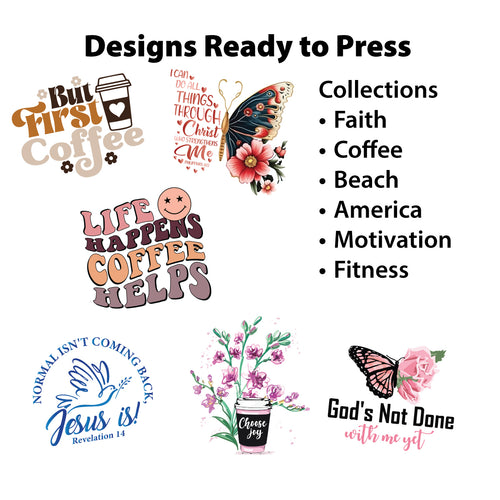
- Schools, sports teams, and event organizers: They tend to order themed runs with a clear deadline. Ready-to-press collections are useful because they cut design time and get shirts moving faster.
- Hobby crafters and DIY makers: They work from a home heat press and usually want simple, reliable transfers. Clear pressing instructions matter more than fancy options.
- Promotional product companies and marketing agencies: They live on deadlines. They need turnaround confidence, file support, and a product mix that handles both apparel and hard goods.
Practical rule: if the order needs design cleanup before it needs printing, don't choose a vendor that treats file prep like an afterthought.
The useful thing about this buyer map is that it turns a product catalog into a workflow. The buyer doesn't have to guess which service line fits, because the job type already points to the answer.
Pricing, Turnaround, and Support That Keep Jobs Moving
The first number most buyers ask about is price, and the second is how fast it leaves the shop. The pricing can go as low as $0.017 per square inch, with gang-sheet density as the main lever on the total cost. That's why layout discipline matters before the order is even placed.
The operational details that protect margin
Shipping speed also matters. Orders ship in 1 to 2 business days, with 24-hour printing, same-day pickup, and next-day air options available. Those choices give a buyer a way to match shipping speed to the deadline instead of baking in unnecessary slack.
The support layer is where a specialty provider either helps or slows you down. Useful services include vectorization, logo and shirt design, the We Build a Gang Sheet for You option, plus ready-to-press collections, pressing instructions, UV sticker instructions, supplies, and blanks. When those pieces are available in one place, the buyer spends less time stitching together vendors.
A simple order checklist
- Confirm the substrate: fabric for apparel, rigid surfaces for UV stickers.
- Check the layout: pack the gang sheet tightly before you pay for film.
- Verify the file quality: clean art saves time on the press.
- Match the deadline: pick the shipping speed that fits the actual due date.
- Ask for help early: file cleanup is easier before the job is in production.
For direct support, buyers can use orders@liondtf.com, 833-350-5466, call, text, email, or website chat. That kind of access matters when a job is sitting on the press and one file still isn't right.
If you're trying to keep shirt jobs profitable without adding more equipment, Lion DTF Transfers is built for that exact pressure point. For fast apparel transfers, gang sheets, UV stickers, and layout help that cuts waste, visit Lion DTF Transfers and get the next order moving with less guesswork.
re scaling.
Email orders@LionDTF.com or Text or Call: 833-350-5466