



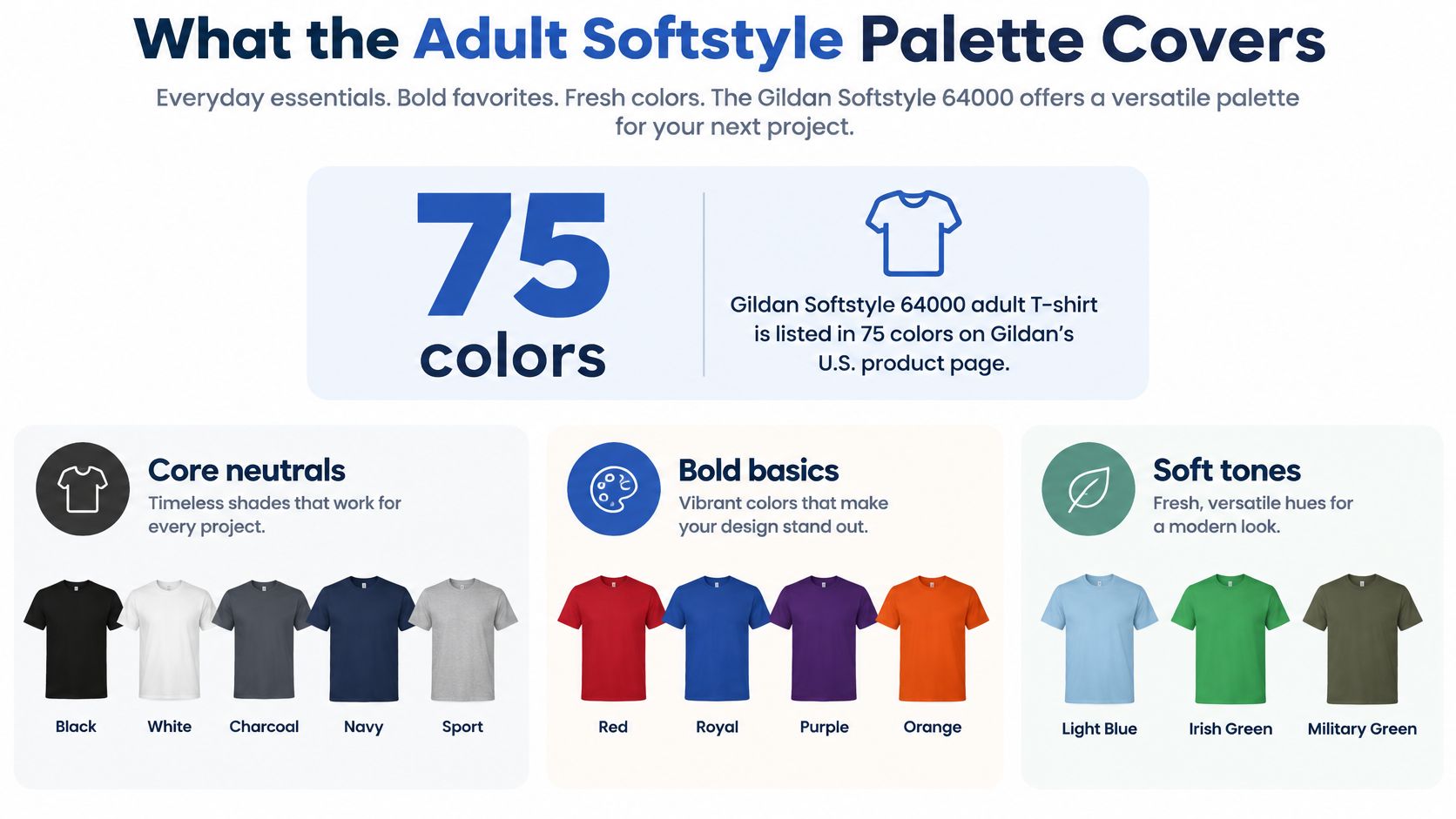
The Gildan Softstyle 64000 adult T-shirt is listed in 75 colors on Gildan's U.S. product page. That breadth gives teams, businesses, and merch sellers plenty of shades to choose from, but a color name alone doesn't tell you how a transfer will look or how the fabric will behave under a press.
The useful way to choose a blank is to pair its color name with its fiber group, then test the transfer on the exact garment. A catalog swatch can help narrow the choice, but it isn't a guarantee of the finished shirt's color or print appearance.
What the Adult Softstyle Palette Covers
The adult 64000's 75 listed colors span familiar basics, vivid shades, and heathered options. Core neutrals include Black, White, Charcoal, Navy, Sport Grey, and Sand. Saturated choices include Cardinal Red, Cherry Red, Kelly Green, Royal, Orange, Daisy, and Purple. The palette also includes Dark Heather, Heather Navy, Heather Purple, Heather Military Green, Indigo Blue, and Military Green.
One style, several kinds of color choice
That range can cover corporate basics, school and team colors, seasonal designs, and fashion-led collections while keeping a lightweight Softstyle blank at the center of the order. A shop can use one artwork file across a light shirt, a dark shirt, and a heather, but it shouldn't assume the same transfer will look identical on all three.
The 75-color count applies to the adult 64000 listing, not every garment in the Softstyle family. The women's 64000L product page shows a separate, narrower selection, so a color offered on the adult shirt may not be available in the women's style. Regional assortments can also differ.
How to use this guide
Start by finding the exact blank name, then identify its fiber group before judging the color swatch. Treat a catalog Pantone reference as a starting point, not a promise that the fabric or finished print will match a chip on a screen.
The next section provides a lookup chart. Later sections sort colors into merchandise-planning families, explain how fiber blends affect transfers, flag look-alike names, outline a shop approval routine, and offer a quick art-to-fabric risk matrix.
One lightweight blank can carry the same artwork across light, dark, neutral, and heather garments. The production rule is simple: test each substrate on its own before approving a run.
Color Names, Fibers, and Pantone Starting Points
Use the chart as a substrate specification, not as a universal digital color reference. It puts each listed color beside its fiber group and a catalog Pantone starting point where one is published. "Not listed" in the Pantone column marks a color without a published code.
The manufacturer identifies the adult 64000 as 4.5-ounce fabric. Solid colors are 100% ring-spun cotton; Sport Grey and Antique shades use a 90/10 cotton/polyester blend; heathers use a 65/35 polyester/cotton blend. Graphite Heather and Heather Oatmeal have their own distinct blends, so don't file them under the general heather or antique labels. These specifications and the color references below come from Gildan's Softstyle adult product information.
| Color | Fiber | Catalog Pantone start | DTF note |
|---|---|---|---|
| White | 100% ring-spun cotton | Not listed | Light base; little or no white underbase |
| Black | 100% ring-spun cotton | PMS 426 | Test white-ink opacity on a dark solid |
| Charcoal | 100% ring-spun cotton | Not listed | Dark neutral; check contrast on fine detail |
| Sand | 100% ring-spun cotton | Not listed | Light neutral; watch thin ink looking washed out |
| Navy | 100% ring-spun cotton | PMS 533 | Don't treat as Heather Navy |
| Royal | 100% ring-spun cotton | PMS 7686 | Saturated team color; compare with Heather Royal |
| Red | 100% ring-spun cotton | Not listed | Solid red; name it as Red, not Heather Red |
| Cardinal Red | 100% ring-spun cotton | PMS 202 | Deeper red; keep separate from Cherry Red |
| Cherry Red | 100% ring-spun cotton | PMS 187 | Brighter red; name it on the order |
| Kelly Green | 100% ring-spun cotton | Not listed | High-chroma solid; sample against brand green |
| Irish Green | 100% ring-spun cotton | Not listed | Solid green; sample against Kelly Green before naming |
| Military Green | 100% ring-spun cotton | Not listed | Solid; not Heather Military Green |
| Light Blue | 100% ring-spun cotton | Not listed | Solid light blue; compare with Carolina Blue |
| Carolina Blue | 100% ring-spun cotton | PMS 659C | School and pastel blue; approve under shop light |
| Orange | 100% ring-spun cotton | Not listed | Saturated solid; check skin tones nearby |
| Daisy | 100% ring-spun cotton | Not listed | Bright yellow; confirm on a physical shirt |
| Purple | 100% ring-spun cotton | Not listed | Solid purple; not Heather Purple |
| Sport Grey | 90/10 cotton/polyester | Cool Gray 7 | Blend, not a cotton grey; check migration |
| Antique shades | 90/10 cotton/polyester | Not listed | Test the exact antique color |
| Dark Heather | 65/35 polyester/cotton | Not listed | White ink and saturation can shift |
| Heather Navy | 65/35 polyester/cotton | PMS 432C | Not Navy; muted, textured ground |
| Heather Royal | 65/35 polyester/cotton | Not listed | Heather, not solid Royal |
| Heather Purple | 65/35 polyester/cotton | Not listed | Heather, not solid Purple |
| Heather Military Green | 65/35 polyester/cotton | PMS 416C | Test the exact heather surface |
| Heather Maroon | 65/35 polyester/cotton | PMS 7634C | Treat as a distinct heather color |
| Graphite Heather | 50/50 cotton/polyester | Not listed | Test separately; its blend differs from other heathers |
| Heather Oatmeal | 99/1 cotton/polyester | Not listed | Treat as its own blend, not a standard antique |
| Heather Red | 65/35 polyester/cotton | Not listed | Not the same print surface as solid Red |
Read the fiber before you trust the swatch
The same transfer can look different when the garment blend or shade changes. A light cotton shirt generally needs less white underbase, while a dark solid calls for an opacity check. On Sport Grey and Antique shades, check for dye migration; on polyester-containing heathers, watch for changes in contrast and perceived saturation.
Graphite Heather is the row that surprises shops most often. It carries the word "heather" yet runs a 50/50 cotton/polyester blend, so it behaves more like a standard blended fleece than like the 65/35 heathers around it. Heather Oatmeal works the opposite way: its nearly all-cotton makeup puts it closer to the solids in print behavior even though the name reads like an antique.
A Pantone association is only a catalog starting point. Yarn composition, dye lot, finishing, lighting, and knit texture can all move the finished shirt away from the chip. For a brand-critical shade, compare a physical shirt or approved swatch under the intended viewing light, and keep artwork in a managed RGB or CMYK workflow until rasterizing it for print. If you're preparing artwork for print, this guide to converting Pantone color to CMYK can help you think through the file workflow.
Color Families for Merchandise Planning
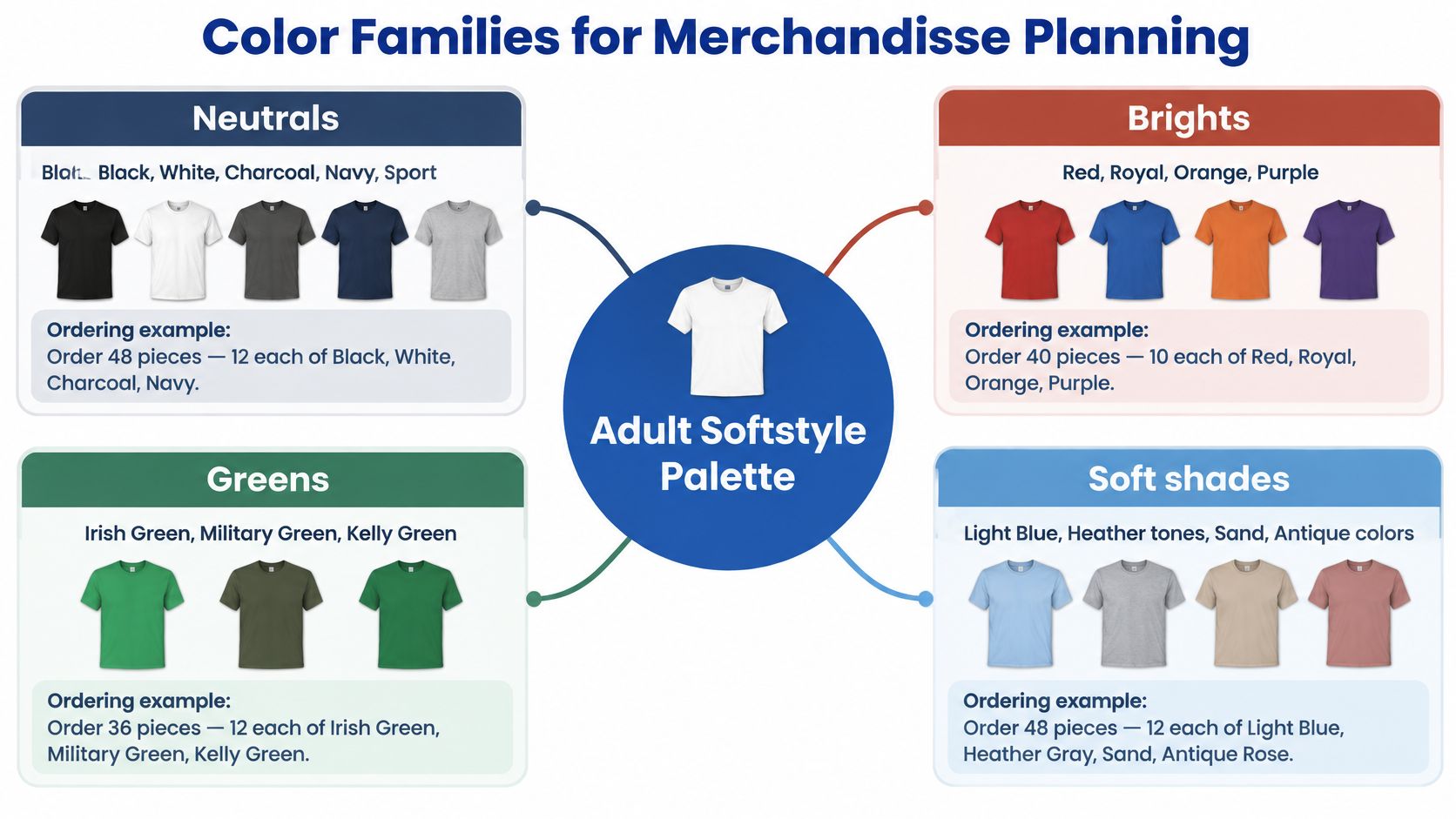
Color families help you narrow a broad catalog into a practical buying decision. Choose according to how the shirt will be used, who needs to wear it, and how much color consistency the artwork requires. The key distinction is that a family may make sense as a merchandise group even when its members don't share the same print behavior.
Neutrals for shared uniforms
Black, White, Charcoal, Navy, Sport Grey, and Sand are straightforward choices for staff basics and corporate apparel. They're useful when several departments share one artwork file or a logo needs to remain readable across a larger order. For example, a café might choose Black for front-of-house staff and Sand for an outdoor event, then approve a sample on each color instead of assuming one approval covers both.
Saturated solids for teams and events
Cardinal Red, Cherry Red, Kelly Green, Royal, Orange, Daisy, Purple, Irish Green, Light Blue, and Military Green offer strong options for school colors, team apparel, and event merchandise. Match the exact name on the order, especially when the customer uses a general description like “red.” Cardinal Red and Cherry Red are different blanks, so the order should specify which one the customer approved.
For a team store, a customer might ask for a deep red hoodie-style look in a T-shirt. Confirm whether they mean Cardinal Red or Cherry Red before preparing the order, and get approval on the actual shirt color.
Heathers and fashion shades for retail-led drops
Dark Heather, Heather Navy, Heather Royal, Heather Purple, Heather Military Green, Indigo Blue, and Graphite Heather bring texture and a more fashion-oriented look. That texture can be part of the appeal, but it also makes heathers a less predictable surface for color-critical artwork. A heather that looks ideal beside a logo on screen may change how its edges, white ink, and saturated colors appear once printed.
Gildan's specifications identify multiple fiber groups, including polyester-containing heathers, Sport Grey and Antique blends, Graphite Heather, and a distinct Heather Oatmeal blend. Those material differences can affect dye migration, perceived vibrancy, and white-ink appearance, especially on darker heathers, as detailed in the Gildan 64000 specification sheet.pdf).
Planning rule: Lock the artwork once, then qualify each garment family with its own test shirt. A white cotton approval doesn't cover a heather.
Antique and grey blends for vintage looks
Sport Grey and the Antique shades can suit a vintage-inspired collection, but treat each exact color as its own substrate during testing. Heather Oatmeal belongs in a separate category because its blend is distinct from the Sport Grey and Antique group.
Use the chart to resolve fiber questions; use a press test to resolve print-behavior questions. A handsome heather can be the wrong choice when a brand mark has to match a precise color.
How Each Fiber Group Takes a Transfer
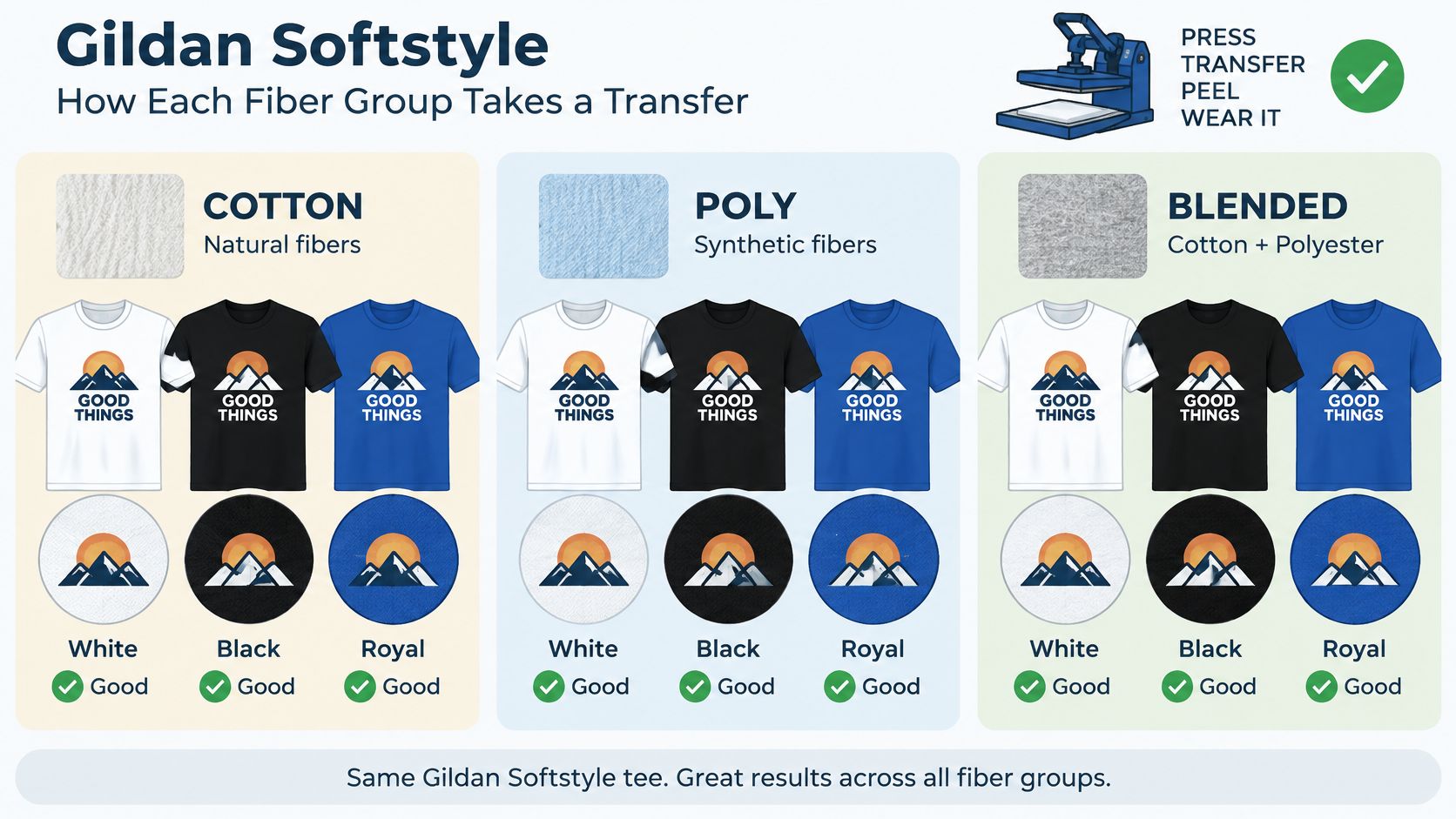
A file can stay unchanged while the printed result shifts, because the shirt beneath it changes. That's why a transfer approved on White cotton is a useful starting point, not an automatic approval for every Softstyle color. Gildan's 64000 specification distinguishes solid colors from blends and textured options, and recommends testing the exact garment for demanding artwork and repeat orders.
Solid cotton
On a solid such as White, Black, Red, Royal, Navy, Purple, Orange, Irish Green, Light Blue, or Military Green, the face is 100% ring-spun cotton. A transfer qualified on White gives you a useful baseline for other solids, but dark garments still need a separate check for white-ink opacity and contrast.
Say a shop has approved a full-chest white logo on White. It should check that logo on Black and Navy too, because a dark ground can change how strong the white looks and whether smaller details stay legible.
Sport Grey and Antique shades
Sport Grey and Antique shades use a 90/10 cotton/polyester blend. The same file may appear flatter than it did on White cotton, and polyester can introduce dye-migration risk. Don't use the white cotton strike-off as the only approval for a grey or antique garment.
For a vintage event shirt, press a small test on the exact Antique color. Judge the white ink and the surrounding colors on that fabric rather than guessing from the name or a product image.
Heathers and special blends
Dark Heather, Heather Navy, Heather Royal, and Heather Purple have a 65/35 polyester/cotton blend. Heathered yarn changes the visual ground, which can affect saturation and the appearance of large white areas, gradients, skin tones, and fluorescent artwork. Graphite Heather is a 50/50 cotton/polyester blend, so give it its own sample even if a different heather has already passed.
The blend details matter whether you're selecting a garment for a customer or deciding which fabrics can be used with DTF transfers. For repeated jobs, put the relevant garment and press details on the ticket so the next run can be compared with the original approval.
A useful approval is a signed physical strike-off, viewed under consistent lighting, followed by a wash test that reflects the customer's care instructions. Record style number 64000, color name, size range, garment lot, press temperature, dwell time, pressure, peel timing, and wash-test result. A pre-shrunk blank is a safer base for this test.
Here's a look at how garment material and transfer choices fit together:
The goal is to avoid treating three different things as though they were one standard: an on-screen swatch, a catalog Pantone approximation, and the shirt after pressing.
Names That Look Alike Across Styles
“Same hue family” doesn't mean “same garment” or “same print surface.” Solid Red and Heather Red may sound like close alternatives, but one is a solid cotton color and the other is a heather. The same distinction matters for Royal and Heather Royal, Navy and Heather Navy, Purple and Heather Purple, and Military Green and Heather Military Green.
Cardinal Red and Cherry Red are a different kind of look-alike pair. Both are solid reds, but they're separate named colors. Ask the customer to select the name on the product listing, not merely approve a general description like “red.”
What the name can't tell you
A customer who asks for Navy may mean the solid Navy, or may have seen Heather Navy in a product photo. One specification associates Heather Navy with PMS 432C, while the solid Navy is listed with PMS 533 in another technical reference. These names and codes help narrow the conversation, but neither guarantees that a garment will visually match a chip under store lighting.
Specifications can also disagree. One 64000 technical sheet gives Black as PMS 426 and Cardinal Red as PMS 202; another cites Black near Cool Gray 11C and Cardinal as PMS 1955C. The second sheet also lists Carolina Blue as PMS 659C, Heather Maroon as PMS 7634C, and Heather Military Green as PMS 416C, according to the Softstyle 64000 reference sheet. Use these references to guide a comparison, not to overrule the actual shirt.
A color code starts a discussion. A physical blank and an approved print settle it.
Check the style, not just the color
The adult 64000 and women's 64000L are separate styles with separate color assortments. If an order mixes them, confirm that the chosen color appears on both product pages before promising one shared colorway. Regional catalogs may also offer fewer colors.
For an online store or team shop, compare near-neighbor blanks under the lighting that will be used for product photography, then approve a printed sample. That matters most for heathers, antiques, and any pair whose names differ only by the word “Heather.” If a customer is choosing a dark heather, a closer look at Gildan Dark Heather can help frame the choice, but a physical sample remains the practical approval.
How to Approve a Color Before a Full Run
A simple approval routine can keep color selection from turning into a last-minute production problem. Run it on the exact 64000 color being ordered, especially if the design has a large white area or the order includes a heather or Antique shade.
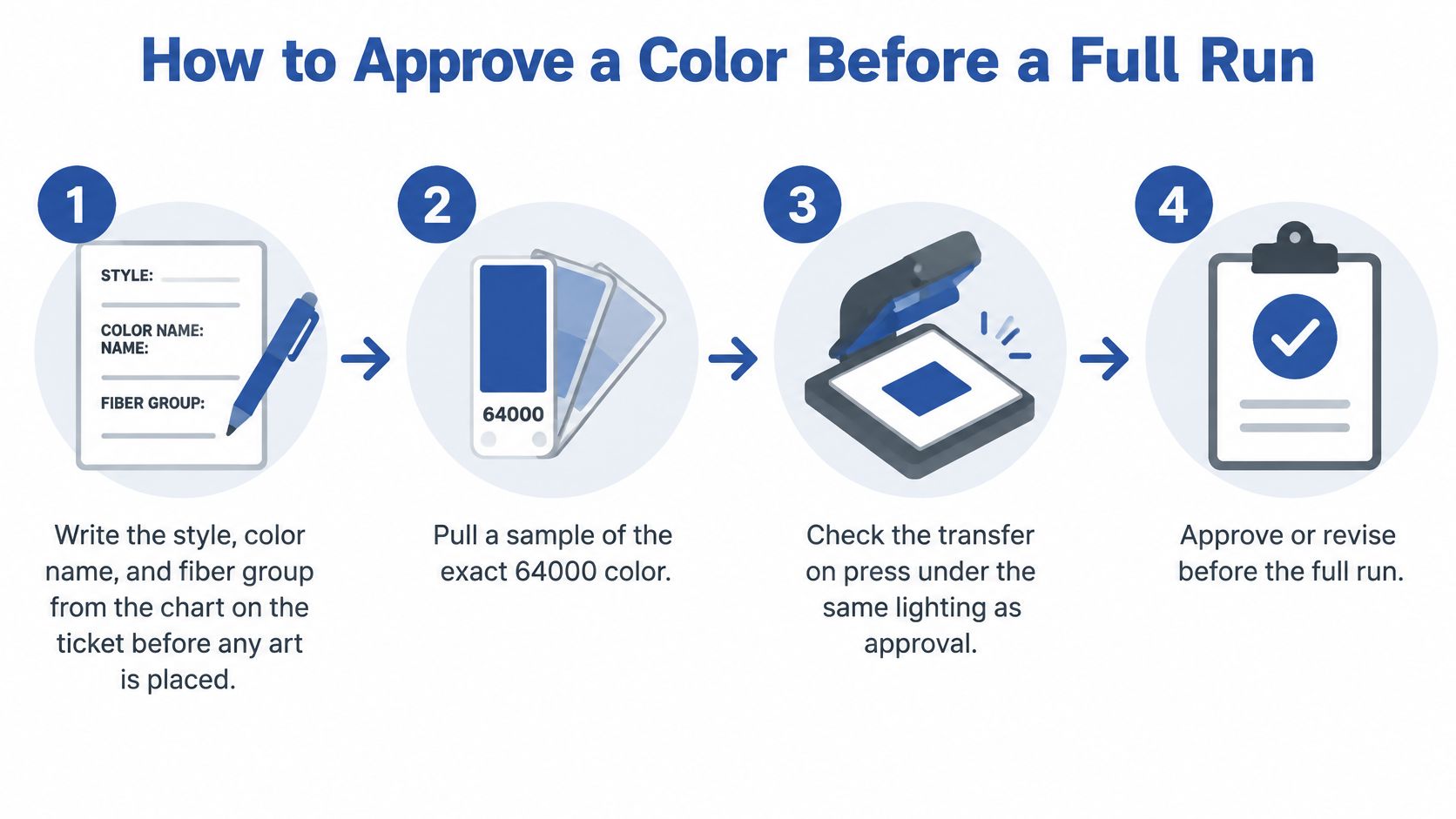
- Write the garment details first. Put style 64000, the exact color name, and its fiber group on the job ticket before placing the artwork. That gives the printer a clear substrate target and helps prevent confusion between near-neighbor names.
- Pull a physical blank. Compare the shirt with the customer's brand chip under the light they'll use to judge the finished garment. A monitor swatch can help with selection, but it can't replace the blank in hand.
- Keep the file managed through rasterization. Maintain the artwork in a managed RGB or CMYK workflow until rasterizing it for print. Note whether it contains large white areas, gradients, skin tones, or fluorescent ink, because each can make a test more revealing.
- Press a strike-off on that color only. Record temperature, dwell, pressure, and peel timing on the ticket. If the order includes both a solid cotton color and a heather, make a second test shirt rather than carrying the first approval across both.
- Judge the printed shirt, not the file. Check white-ink opacity and color density on the garment itself. Compare the result under the agreed lighting and note any visible change in fine detail or saturation.
- Wash-test before committing to the run. Follow the wearer's care instructions, then compare the dried garment with the signed strike-off. If the customer plans to wash the shirt inside out, keep that in the test notes too.
- File the decision with the lot number. Mark the sample pass or fail and keep the record so a reorder can start from the same color name and approval reference.
Steps one through five can usually be completed on the same day. Step six needs time for washing and drying, so don't treat a same-day press test as the finished approval for a large heather or Antique order.
Two common shortcuts cause avoidable trouble: qualifying a transfer only on White cotton, and treating a Pantone code as the finished garment. Stop when you have a signed physical sample and a documented wash result. The matrix below is a quick way to decide which artwork deserves the closest test.
Artwork and Garment Pairing at a Glance
This matrix is for the moment you know the shirt color and need a quick sense of the artwork risk. It focuses on three substrate groups: 100% cotton solids, 90/10 Sport Grey and Antique shades, and heathers or Graphite Heather. Choose the action for the combination you'll print.
| Artwork | 100% cotton solids | 90/10 Sport Grey and antiques | Heathers and Graphite Heather |
|---|---|---|---|
| Small solid logo | One cotton test is usually enough | Check flatness and dye migration | Press that heather; texture shows at edges |
| Large white field | Check opacity on dark solids | Test white on the grey or Antique | Highest risk; sample the exact color |
| Photo or skin tones | Approve on the actual solid | Expect a flatter result | Sample; polyester and heather can shift hue |
| Gradient or soft edge | Fine on light cotton; check dark solids | Watch for banding on the blend | Texture can break the gradient |
| Fluorescent or high-saturation ink | Compare with a physical solid | Saturation may drop | Sample; heather can dull chroma |
| Same art on several colors | Retest each dark solid | Don't copy the White-cotton pass | Make a separate strike-off per heather |
Three quick checks before you order
If two color names differ only by “Heather,” treat them as different production rows. If you're ordering the 64000L, confirm that the chosen color exists on that style before promising it. If two specification sheets disagree about a Pantone reference, trust the physical shirt you've approved, not the apparent certainty of the code.
The most useful matrix result is “sample first.” That's usually the call for white-heavy art on a dark heather and for a brand-critical color on an Antique garment. Once the sample passes, group the approved artwork and sizes together rather than ordering each small transfer on its own.
Group Designs on One Gang Sheet
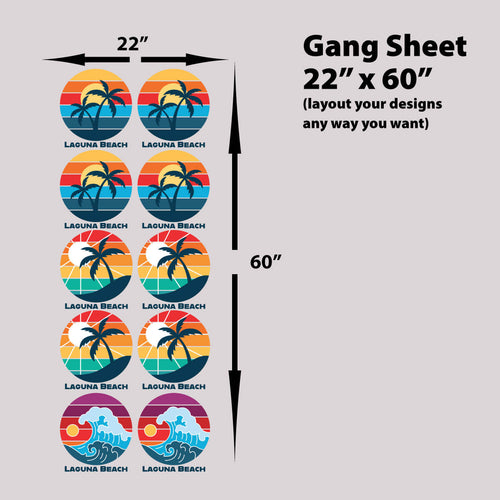
Once the color and strike-off are approved, build the order around what passed. A gang sheet is useful when the job has two or more designs, or when one design needs youth, adult, coach, and fan sizes across several Softstyle colors. Treat each approved surface as its own line item: Sport Grey, a heather, an Antique shade, and Graphite Heather can carry the same file name while changing white-ink contrast and dye-migration risk.
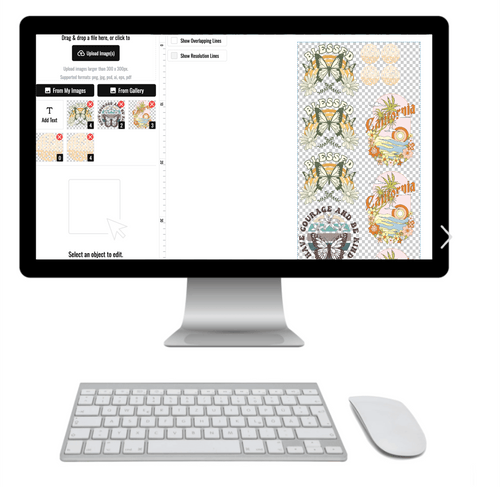
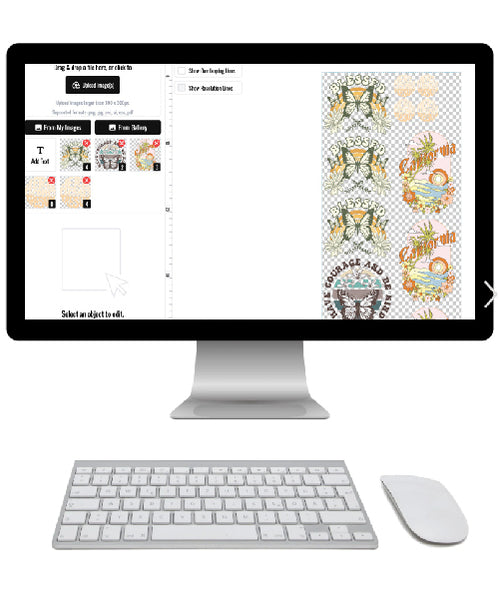
For two or more designs, the online gang sheet builder is the most cost-effective ordering path. Upload the images, size each one, set quantities, and click apply. Lion DTF Transfers' online gang sheet builder lets you place several approved graphics on one sheet, so a run of left-chest logos, sleeve marks, and full-front art stays together instead of becoming separate small orders.
Use the product's exact color wording in the notes. If the shirt is Heather Navy, write Heather Navy; if it is Sport Grey, Antique Cherry Red, or Graphite Heather, say that instead of relying on a family name. Keep the approved physical shirt with the job record when one sheet feeds more than one colorway, because the pass on White cotton does not clear the same art on a polyester-rich heather.
Custom online gang-sheet creation is available, with DTF pricing starting at $0.017 per square inch. If the critical 64000 shade is still only a catalog swatch, get the blank or a sample press before scaling up. Approve the shirt first, then build one gang sheet for the sizes and designs that passed on that color.
Lion DTF Transfers offers an online gang sheet builder for arranging approved designs and sizes together, with DTF pricing starting at $0.017 per square inch. Once your Softstyle color is approved on a physical sample, visit Lion DTF Transfers to build a sheet around the artwork and garment colors ready for production.