
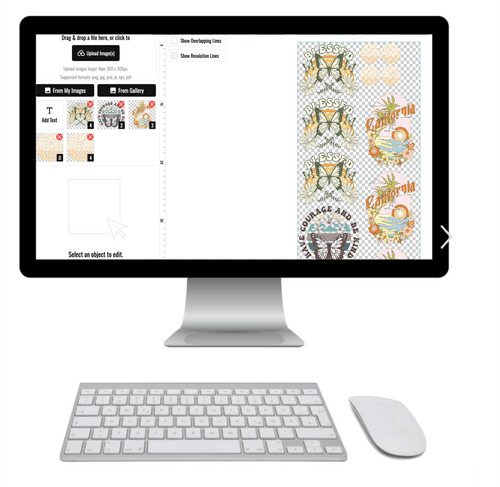
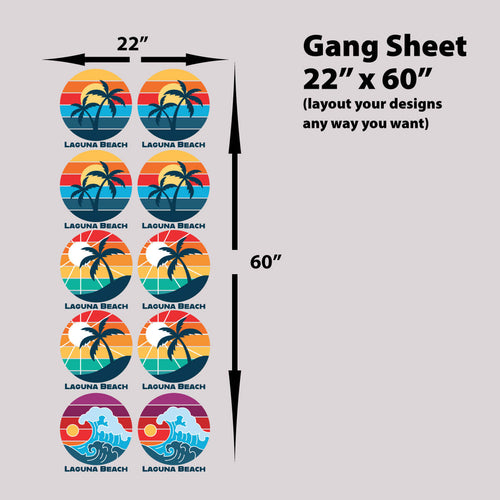
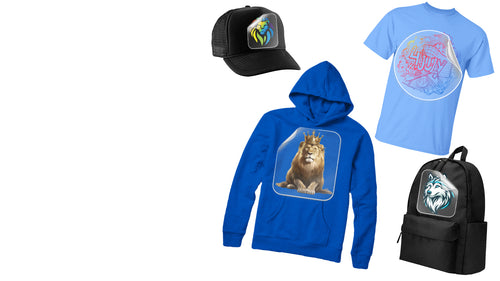
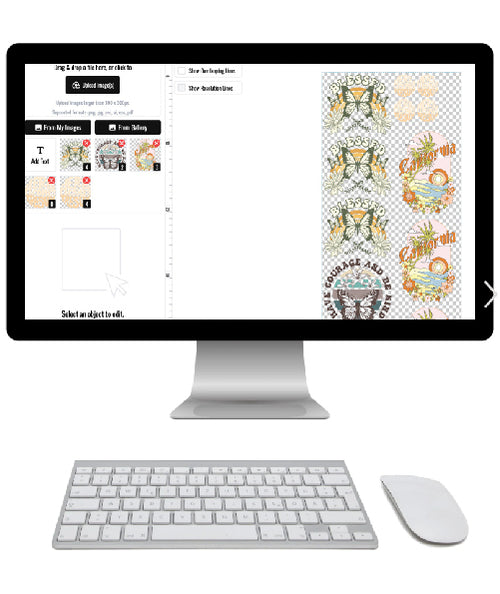
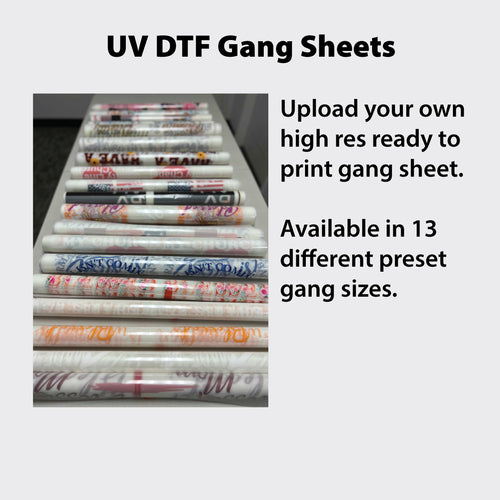
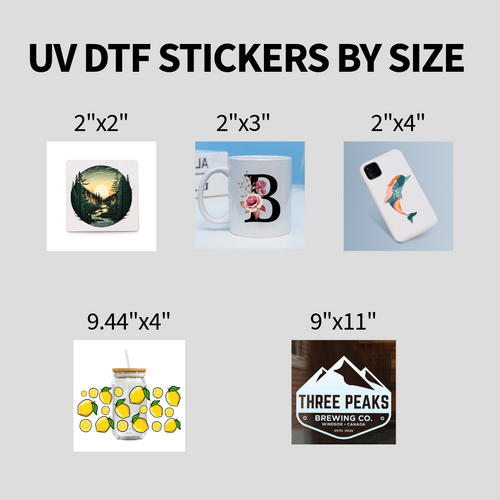
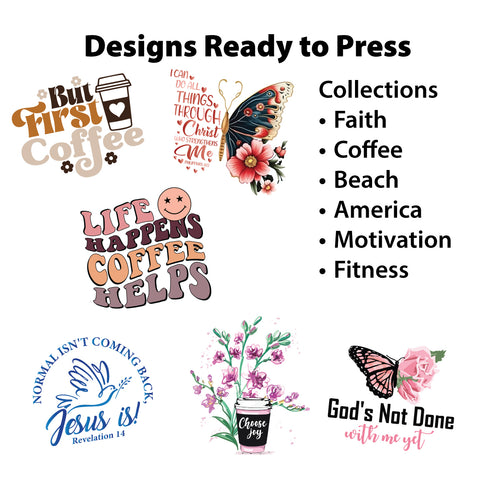


A custom UV DTF gang sheet is the single most effective way to drive down your cost per sticker while cutting down on material waste. It’s a large adhesive sheet that you fill with multiple designs, making it perfect for creating vibrant, tough, professional decals for hard goods like tumblers, laptops, and phone cases. Think of it as the smart way to handle high-volume custom sticker production.
Why UV DTF Gang Sheets Are a Game-Changer

Ever wondered how businesses and creators churn out those stunningly detailed stickers for mugs, tumblers, and promo items so fast? The answer is almost always a custom UV DTF gang sheet. This method is a massive leap forward from printing individual stickers, offering serious efficiency for everyone from small business owners to large promotional companies.
The "gang" in a gang sheet simply refers to the practice of "ganging up," or grouping, multiple print jobs onto one large sheet. Instead of printing one design at a time, you fill the entire sheet with as many different designs as you can possibly fit. This approach changes everything for a few key reasons.
The Real-World Benefits of Ganging Up Your Designs
At its core, using a custom UV DTF gang sheet is all about maximizing value. By printing a bunch of designs together, you consolidate material and labor costs, which directly slashes the price of each individual sticker. It’s an incredibly cost-effective way to produce custom decals, especially for small businesses trying to manage tight budgets. To maximize these savings effortlessly, our Auto-build gang sheet builder automatically arranges your designs for optimal space usage, guaranteeing cost-effectiveness.
But the advantages don't stop at cost. This method also gives you incredible creative freedom. You can print multiple logo variations, a full set of themed designs for a new product launch, or personalized stickers for an event—all on one sheet. That’s a level of versatility that single-sticker printing just can't compete with.
To see just how powerful this is, let's look at the main advantages.
UV DTF Gang Sheet Benefits at a Glance
This table breaks down the core advantages of using custom UV DTF gang sheets, making it easy to see the value for your business or creative projects.
| Benefit | Description for Your Business |
|---|---|
| Cost Efficiency | By printing many designs at once, your cost per sticker drops significantly, boosting your profit margins. |
| Material Savings | You use the entire sheet, which means far less wasted film and ink compared to single-sticker printing. |
| Creative Freedom | Test new designs, print multiple colorways, or offer a variety of stickers without committing to large, single-design runs. |
| Time Savings | One print run produces dozens or even hundreds of stickers, streamlining your production workflow. |
| Durability | UV-cured ink creates a permanent, scratch-resistant, and waterproof decal that stands up to heavy use. |
| Easy Application | No heat press is needed. It’s a simple peel-and-stick process that works on almost any hard surface. |
As you can see, the benefits go far beyond just saving a few cents. It's about working smarter, not harder.
Unmatched Durability and Versatility
What really sets UV DTF apart is its incredible durability and the sheer number of things you can apply it to. The "UV" refers to the ultraviolet light that instantly cures the ink and a protective varnish layer. This process creates a decal that is:
- Scratch-resistant: Built to handle the daily wear and tear on high-touch items.
- Water-resistant: Perfect for products like water bottles, coolers, and outdoor gear.
- Vibrant: The colors pop with a glossy, premium finish on any surface, light or dark.
These stickers stick to almost any hard, non-porous surface you can think of—glass, metal, plastic, treated wood, and ceramics. Best of all, they require no heat press. It’s a straightforward peel-and-stick application that delivers a permanent, professional finish every time. You can get a deeper look at the technology in our guide explaining what UV DTF is.
The industry growth speaks for itself. The global UV DTF market is on track to hit USD 1.5 billion by 2033, with a strong 10.5% compound annual growth rate. This boom is driven by high demand for durable prints that don't need complex pre-treatment, which is a key reason why an estimated 70% of professional print shops had added DTF services by 2024.
Key Takeaway: The primary goal of a custom UV DTF gang sheet is to dramatically reduce your cost per sticker by printing multiple designs at once, making it the most efficient method for producing high-quality, durable decals for hard goods.
To make this even easier, we developed our Auto-build gang sheet builder. This tool automatically nests your uploaded designs to use every square inch of the sheet, guaranteeing you get the absolute lowest cost per sticker without any manual work. It’s the simplest way to unlock the full economic power of gang sheet printing.
Getting Your Artwork Ready for Flawless UV DTF Prints
Let's be honest: the quality of your final sticker comes down to the quality of your digital file. It’s the single most important part of the process. A great-looking custom UV DTF gang sheet starts long before the printer even warms up. We’re going to walk through exactly what you need to do to get your files ready, skipping the confusing tech-speak so your designs print perfectly every time.
The backbone of any sharp, professional print is its resolution. For UV DTF stickers, the magic number is 300 DPI (dots per inch). This figure dictates the clarity and sharpness of your final product. If you try to use a low-resolution file, like a 72 DPI image pulled from a website, the result will be blurry, pixelated, and just plain unprofessional.
Think of it like trying to blow up a small, grainy photo to fit a billboard—it gets fuzzy and distorted. Starting with a 300 DPI file ensures your stickers come out crisp and vibrant, with clean lines that make your products look premium.
File Format and Why It Matters
When you’re ready to upload, the only file format you should be using is a PNG (Portable Network Graphics). The reason is simple and non-negotiable: PNGs support transparent backgrounds. This is absolutely critical for creating clean, die-cut stickers that appear printed directly onto the surface.
If your design has a solid white or colored background, that box is going to print right along with your sticker. A transparent background guarantees only your design gets printed, creating a sleek decal with no unwanted borders. Always double-check that you've enabled transparency when saving your file.
Fine-Tuning Your Design for Print
You also have to think about the physical side of printing and application. Some on-screen effects just don't translate well to a physical sticker. Tiny details can be a real headache.
- Mind the Gaps: Any line or freestanding element thinner than 0.05 inches (around 1.27 mm) is risky. It might not have enough surface area for the adhesive to grab hold, causing it to peel or fail during transfer.
- Watch for Stray Dots: Tiny, isolated specks in your artwork can easily get lost during printing or just won't transfer correctly. Give your design a quick once-over to clean up any stray pixels.
- Avoid Soft Edges: Effects like "glows" or "feathered" edges look great on a screen but are a nightmare for UV DTF. They lack the hard, defined edge the printer needs to create a clean cutline, which leads to a messy, incomplete sticker.
Stick to clean, solid lines and shapes. A quick review of your artwork for these common issues can save you from a major disappointment when your order arrives.
The Magic of White Ink and Varnish
One of the secrets behind the incredible look of UV DTF stickers is how they're layered. It’s more than just colored ink. Every design automatically gets a white ink underbase and a protective varnish topcoat—you don’t have to do anything to set this up.
First, a layer of white ink goes down directly under your design. This is what makes your colors pop, ensuring they look bright and opaque even when you stick them on a dark or colored object. Without it, your colors would look dull and transparent on anything but a white surface.
Next, your color design (CMYK) is printed on top of that white base. To finish it off, a clear layer of varnish is applied over the entire design. This glossy topcoat protects the sticker from scratches, water, and fading, while also giving it that signature high-shine, premium feel.
This automatic layering of white ink and varnish is what gives UV DTF its incredible durability and pop. It ensures your designs look fantastic on any surface without you needing to do any complex file prep.
We get it—prepping files can be a grind, especially when you have a ton of different designs. That’s why we built our Auto-build gang sheet builder. It’s made to be easy and save you money. Just upload all your 300 DPI PNG files, and the tool handles the rest.
Our system doesn't just check for common problems; it automatically nests your designs to pack them in as tightly as possible, getting rid of wasted space. This is the fastest way to build a custom UV DTF gang sheet, saving you time on manual layouts and money by fitting more designs onto every sheet. It’s the most direct path from a digital file to a perfect physical product.
Maximize Your Gang Sheet for Efficiency and Savings
Once your artwork is print-ready, it’s time to move on to the step that separates a good project from a great one. This is all about making the most of the real estate on your custom UV DTF gang sheet to squeeze every drop of value from every square inch. The goal is to fit as many designs as possible onto your chosen sheet size in a process we call nesting.
Think of it like playing Tetris with your own designs. The more efficiently you can arrange them, the less empty space you end up paying for. This translates directly to a lower cost per sticker and, if you're a business, a higher profit margin. Leaving big gaps on your sheet is literally leaving money on the table.
This is the general flow for getting your art ready for perfect nesting.

Starting with high-resolution files that have transparent backgrounds and solid, clean lines is the foundation for any successful gang sheet.
Manual Nesting vs. Automated Efficiency
Sure, you could open up a design program like Adobe Illustrator or Affinity Designer and start placing every sticker by hand. For just a handful of designs, that might seem doable. But it gets tedious—and fast.
You'd be dragging, dropping, rotating, and repositioning each individual design, trying to solve a spatial puzzle that’s surprisingly hard to get right. More often than not, trying to nest by hand leads to awkward gaps and a lot of wasted, paid-for material.
Key Takeaway: Manually arranging designs on a gang sheet is slow and inefficient, often leading to wasted material that you still have to pay for. This inefficiency directly increases your cost per sticker.
This is exactly the problem we wanted to solve for our customers. We saw the frustration and wasted money that manual nesting was causing, which is why we developed the Lion DTF Auto-Build Gang Sheet Builder. For anyone ordering a custom UV DTF gang sheet, it’s a total game-changer for both its ease of use and cost-effectiveness.
The Power of the Auto-Build Gang Sheet Builder
Instead of spending an hour meticulously arranging your artwork, our Auto-Build tool does it for you in seconds. You just select your gang sheet size, then upload all of your individual PNG files at once. Our software’s algorithm immediately gets to work, analyzing the unique shape and size of each design.
It automatically rotates and nests every image as tightly as possible, filling in the small gaps with your smaller designs to use every available inch. This automation not only saves you an incredible amount of time but also guarantees the most cost-effective layout—something that’s nearly impossible to achieve by hand. For anyone looking to produce stickers efficiently, it's really the only logical choice. You can explore a deep dive into gang sheet benefits in our article to see more real-world examples.
Real-World Savings: A Small Business Case Study
To really understand the impact, let's compare two scenarios for a small business, "Crafty Creations," that's launching a new line of ten unique sticker designs for tumblers. They need 20 of each design, for a total of 200 stickers.
Scenario 1: Manual Nesting
- The owner spends an hour painstakingly arranging the 200 stickers on multiple 22"x60" gang sheets.
- Due to human error and the sheer difficulty of optimizing space, they end up with about 20% wasted space on their sheets.
- This inefficiency forces them to order an extra sheet just to fit all their designs, driving up their material cost and cutting into their profit on the launch.
Scenario 2: Using the Auto-Build Gang Sheet Builder
- The owner uploads all ten design files and simply sets the quantity for each.
- The Auto-Build Gang Sheet Builder instantly nests all 200 designs, reducing the wasted space to less than 5%.
- The entire process takes less than five minutes. The optimized layout fits all the designs onto fewer sheets, directly slashing the total order cost.
The conclusion is clear: automation delivers significant savings in both time and money. The efficiency you get from our builder makes producing a custom UV DTF gang sheet more accessible and profitable than ever.
This kind of efficiency is what’s driving incredible market growth. Sales momentum for DTF gang sheets on major platforms like Amazon shows a massive 183% jump in projected sales from early 2024 to late 2025. For screen printers, DIY crafters, and e-commerce sellers, this method means packing more designs onto a single sheet to slash costs—ideal for outfitting teams or launching new merch.
At Lion DTF, we even take this a step further with our "We Build a Gang Sheet for You" service, offering a completely hands-off solution for those who want perfect nesting without lifting a finger.
Navigating the Ordering Process with Confidence
With your artwork dialed in, it's time to place your order and bring your custom UV DTF stickers to life. The checkout process should be simple, and knowing your options beforehand makes everything run smoothly.
Your first decision is the size of your gang sheet. We offer standard sizes like 22"x24" and 22"x60", but the best choice really depends on your production needs. A smaller 22"x24" sheet is great for a test run or a small batch of stickers. For larger production runs, the 22"x60" sheet offers a much better value, bringing your cost-per-sticker way down.
Choosing Your Ordering Method
We know every creator's workflow is different, so we offer three ways to get your order into production. Each is built to give you the right balance of control, convenience, and cost.
-
Use Our Auto-Build Gang Sheet Builder: This is our most powerful and recommended tool. Just upload all your designs, and our software instantly nests them for maximum efficiency. It's the most cost-effective option and ensures you don't pay for any wasted space on the sheet. It's renowned for its ease of use.
-
Upload a Pre-Built File: If you're a design pro who has already arranged your artwork into a print-ready file, this is the option for you. Simply upload your finished gang sheet, and we'll take it from there.
-
Let Us Build It for You: For a completely hands-off experience, select our "We Build a Gang Sheet for You" service. Our experts will take your individual design files and create an optimized layout, guaranteeing a professional result without you having to lift a finger.
No matter which route you choose, our goal is the same: to get you a perfectly printed custom UV DTF gang sheet with zero hassle.
Meeting Your Deadlines with Speed and Precision
In the world of e-commerce and promotional products, speed is everything. This is especially true in the rapidly growing DTF printing industry, which hit a value of $782.1 million in 2023 and is projected to reach $2.1 billion by 2030. With North America holding a 32% market share, providers who deliver both quality and speed are the ones leading the pack. You can dive deeper into these impressive DTF industry statistics to see just how fast things are moving.
We built our entire operation around this need for speed. We offer a 24-hour printing service to get your order into production fast, ensuring your project never misses a beat.
When it comes to delivery, we provide a range of options to fit your timeline and budget. This includes next-day air shipping for those urgent, can't-miss deadlines. Our commitment is to make the entire journey—from the moment you click "checkout" to the second your package lands on your doorstep—as clear and reliable as possible.
Applying Your UV DTF Stickers for Professional Results

You’ve done the design work and your custom UV DTF gang sheet has arrived. Now it's time for the fun part—application. This is a simple peel-and-stick process, but a few key techniques separate an amateur job from a truly professional finish that lasts.
Unlike traditional decorating methods, you won't need a heat press or any complex equipment. A clean surface and a bit of care are all it takes to get a permanent, vibrant result that looks like it was printed directly onto the product. This is where your hard work really pays off.
The Application Process From Start to Finish
The secret to a flawless application isn't complicated: it all starts with a perfectly clean surface. Any dust, oil, or fingerprints can interfere with the adhesive and compromise the bond.
First, wipe down the application area with isopropyl alcohol and a lint-free cloth. This is a non-negotiable step for getting maximum adhesion. Make sure the surface is completely dry before you move on.
Next, figure out your placement. Before peeling anything, position the sticker—with its backing and carrier film intact—on the object to find the perfect spot. On curved items like tumblers, you can even use a small piece of masking tape to create a "hinge," holding it steady while you work.
Once you're happy with the position, it's time to burnish. Rub firmly over the entire design with a squeegee or the edge of a credit card. This ensures the decal sticks completely to the clear carrier film. Now, you can carefully peel away the solid clear backing, leaving your sticker on the transparent film.
Gently apply the sticker to the surface, starting from one edge and smoothing it outward to push out any air. Once it’s on, burnish it again, this time pressing the design firmly onto the object itself. Give extra attention to the edges and any fine details in your artwork.
Finally, slowly peel back the clear carrier film at a sharp angle. If you see any part of the sticker starting to lift, just lay the film back down, burnish that specific spot again, and then continue peeling. Once the film is off, the design is permanently bonded.
For a deeper look at the process, you can check out our detailed guide on working with UV DTF stickers.
Troubleshooting Common Application Issues
Even when you're careful, small issues can pop up. Don't worry—most are an easy fix.
Problem: Stubborn Air Bubbles
If you spot a small air bubble, you can usually work it toward the nearest edge with your finger or a squeegee. For a bubble trapped in the middle of the design, just prick it with the tip of a fine needle to create a tiny, invisible hole and press the air out flat.
Problem: Edges Aren't Sticking
This is almost always caused by a contaminated surface or not using enough pressure during the burnishing step. Try pressing the edge down again firmly with your thumbnail. If it’s still not sticking, a very quick blast of gentle heat from a hairdryer on a low setting can sometimes help activate the adhesive. Just be extremely careful not to overheat or melt the decal.
Expert Tip: After applying your UV DTF sticker, let it cure for at least 24 hours before any washing or heavy use. This gives the adhesive time to fully set and create the strongest possible bond for long-term durability.
By following these application and troubleshooting steps, every decal from your custom UV DTF gang sheet will look sharp, professional, and be built to last.
Your UV DTF Gang Sheet Questions, Answered
Even after getting the hang of the process, a few questions usually pop up. We get it. Here are some quick, straightforward answers to the most common things people ask when ordering a custom UV DTF gang sheet.
What Surfaces Can I Apply UV DTF Stickers To?
UV DTF stickers are designed for almost any hard, non-porous surface you can think of. This includes glass, metal, plastic, treated wood, ceramics, and acrylics. They’re a game-changer for customizing things like mugs, tumblers, phone cases, and laptops.
Unlike vinyl, you don't have to do any weeding, and you can print full-color, highly detailed designs. Just remember they aren’t made for fabrics or any soft, flexible material that can stretch or bend.
How Do I Make Sure My Colors Print Accurately?
For the truest colors, always design your files in a CMYK color profile. Save them as high-resolution (300 DPI) PNG files with a transparent background. Our printers have advanced color-matching tech, but starting with CMYK gives you the most predictable results.
If you’re not 100% confident in your file setup, our Auto-build gang sheet builder is designed to take the guesswork out of it. The builder automatically optimizes your files to ensure they’re ready for vibrant, precise printing every time. It's the most reliable and cost-effective way to get a professional custom UV DTF gang sheet.
Is an Auto-Build Gang Sheet Builder Really More Cost-Effective?
Absolutely. When you arrange designs by hand, you almost always end up with wasted space on the sheet that you’re still paying for. That inefficiency drives up your cost per sticker and can eat into your budget, especially on bigger jobs.
Our Auto-build gang sheet builder uses a smart algorithm to "nest" your designs as tightly as possible. This process cuts out the wasted space, fits more prints onto each sheet, and directly lowers your cost per sticker. It's simply the smartest financial choice.
This tool was built to be easy to use while giving you the best possible return on your investment.
How Durable Are UV DTF Stickers Compared to Vinyl?
UV DTF stickers are much more durable, which is why so many creators use them for premium products. The ink and varnish are cured with UV light, creating a tough finish that is naturally:
- Scratch-resistant
- Water-resistant
- Fade-resistant
This makes them perfect for items that get a lot of use or are exposed to the elements, like water bottles, coolers, or outdoor equipment. They're built for longevity on hard goods. Once applied and left to cure for 24 hours, they become permanent.
Ready to create impressive, durable decals with total efficiency? At Lion DTF Transfers, we provide the tools and expertise to make it simple. Build your own high-quality custom UV DTF gang sheet today and see how easy it is to get professional results. Start your project at https://liondtf.com.